The number one go-to-resource for B2B marketers across the globe


News, analysis and expert opinion from B2B Marketing — all in one place.
12,867 results · page 137 of 537

Companies that trade on their values will find it increasingly difficult to remain neutral in a polarised political environment, argues Claire Mason, CEO of Man Bites Dog. The separation of business and politics has long been considered sacrosanct. While companies lobby to influence industry and legislative issues, at a macro policy level they generally aspire to be nonpartisan.Why? Because political bias can alienate employees and customers alike, and in extreme cases can affect the favourability of the regulatory environment and a company’s licence to operate. What’s more, an outspoken opinion can set an expectation that lasts a lifetime in the digital age.
30 June 2017 · Content, Creative & Campaigns

Some 40% of the world’s most influential CMOs work in the technology, telecoms or IT sector. A ranking of the top 50 most influential CMOs globally – carried out by Forbes, social media management system Sprinklr and LinkedIn – found financial services was the next best-represented sector with nine representatives. Almost three-quarters of the top 50 have been in their role for fewer than three yearsThe highest ranked CMO from a purely B2B company was Cisco CMO Karen Walker, who was positioned at number 10 on the list.
30 June 2017 · Content, Creative & Campaigns

If you were lucky enough to be one of the 1000+ bright sparks at Ignite 2017 - B2B Marketing's annual B2B festival in the Business Design Centre on June 22nd - you'll have seen the White Collar Videos team filming as the official video partners for the event, and offering a day's free filming to winner of their video pitch competition. Now, the winner is revealed.
29 June 2017 · Content, Creative & Campaigns

Some 64% of marketing leaders say their company has become more focused on providing a consistent experience across every channel as a result of changing customer expectations, according to a report by Salesforce. This shift in focus over the past 12 months has been driven by the fact that customers expect consistent, personalised experiences.
29 June 2017 · Customer Experience

Random acts of kindness are those generous little deeds that can make someone’s day – buying coffee for the person behind you in line or mowing a neighbor’s lawn, for example. Random acts of marketing, however, aren’t so kind. In fact, they can ruin a brand.Disjointed, poorly timed or just plain stupid marketing outreach can alienate prospective buyers and existing customers, or send them running to competitors - directly affecting a business’s bottom line. As the ways customers engage with brands continue to change and multiply across channels, it’s important for marketers to think holistically about all these unique, and oftentimes digital touch points throughout the customer journey, and try to provide a seamless and consistent brand experience at all intersections.Now layer in the complexities of marketing to multiple decision makers within a business, and random acts of marketing within your customer journey can almost feel like an inevitable outcome. However, it doesn’t have to feel so daunting! I oftentimes find it easier to focus on the things that you don’t want first. So, here’s eight examples of marketing randomness to avoid, in no particular order:
29 June 2017 · People, Teams and Skills

When it comes to conversion, email is the king of all marketing tactics. That is because email has the highest return on investment (ROI) over any other digital channel. However, those returns will only happen if your campaigns can convert your email audience into customers. Altering specific elements of your email campaign may potentially be the key to improving your conversion rates. Sometimes, something as simple as tweaking the subject line, may make the difference between high and low open rates. In this article, we will cover 5 essential steps your marketing team should implement to increasing the conversion rates of your email campaigns.
29 June 2017 · Content, Creative & Campaigns

Almost half of B2B marketers send leads to sales without scoring them. That’s one of the findings from research carried out by B2B Marketing, in association with Cyance, among 146 B2B marketers. The remaining 52% were split equally between those marketers that have automated the lead scoring process, and those who carry it out manually.Paul Snell, deputy editor at B2B Marketing, said: “The research found one of the top priorities for marketers is ensuring sales converts its opportunities. But it’ll be difficult to for sales to achieve this if they’ve no indication of a potential prospects’ value or likelihood to convert.”
29 June 2017 · Content, Creative & Campaigns

Increased costs, integration problems and a lack of support service resource are some of the problems that can arise following a martech investment. But what else do marketers need to be aware of and how can they avoid the pitfalls?1. Decide whether you need to integrate new and existing tech or replace your current platform/software completelyBen Wightman, channel and sales enablement director, Asia Pacific, gyro: As with any investment, it comes down to a business value assessment. If the existing tech is preventing the company from growing through effective demand generation and lead management, it may be time for a rip-and-replace strategy. But if it’s just a single part of the martech that isn’t optimised, then just integrating new tech into the existing infrastructure would likely work fine. Most mainstream martech systems have application program interface (API) linkage with cloud systems like Salesforce.com and Oracle Marketing Cloud. By ensuring there are built-in API connectors – which enable the programs to seamlessly communicate with each other – extra integration costs can be minimised.Rishi Dave, CMO, Dun & Bradstreet: If you’re going to integrate new tech with existing platforms/software, the same data has to flow through all systems to ensure customers get the right customer experience, and all salespeople and marketers are operating from the same clean, integrated and structured data set...
28 June 2017 · Marketing Operations and Technology (MarTech)
Jess Pike speaks to the experts to find out what it takes to make a success of programmatic, what to consider before you select a provider and how to seize back some buyer control.So if the programmatic pros outweigh the cons (and many brands, despite the naysayers, do continue to invest), how do you go about selecting a provider? Many purport to offer the same benefits, so it’s only until you get under the metaphorical hood that you’re really able to differentiate. “Even then it might be a bit tricky,” points out Alina Morkin, VP marketing at Voices.com. “One of the main things that determines their success is the effectiveness of their algorithm, but that’s a bit of a black box because each is proprietary.”So what can you reasonably expect to judge them on? Well, first consider past successes and customer testimonials; then evaluate whether they’ll be able to provide you with metrics you need. Is the ramping up period fast enough for you? When the algorithm’s optimised, what’s the anticipated click through and subsequent conversion rate? “Ensure you have visibility into what is happening, and expectations around what you should be seeing and when,” says Alina. “Check that the pixel being used doesn’t have an impact on your site load times. (A pixel is a little snippet of code that’s dropped onto a visitor's browser, so you can track whether they’ve viewed or clicked on an ad or message, and made a purchase.) And bear in mind the fact that the more specific your customer – and the less traffic you have currently from that type of person – the longer the ramp time (ie. spend with little to show for it).”It’s also worth noting that buying ads in the open real-time bidding marketplaces, rather than the private marketplaces, is risky – and brands should consider investing in ad tech that incorporates brand safety, anti-fraud and contextual relevance functions to help counter some of the potential risks.
27 June 2017 · Content, Creative & Campaigns

At first sight, establishing a brand or attracting new groups of customers in the B2B financial services sector appears to be a tough task.In most areas, there are large incumbents with well-established brand positionings who invest heavily in brands, believing (a la Byron Sharpe) that outspending their competitors is the key to maintaining market share. And as media consumption habits fragment, many brands feel they have even more ground to cover, and therefore require larger budgets to remain in the game. Take the investment management sector, for example; Fidelity, M&G Investments and Blackrock have each spent in excess of €10M across Europe over the last 3 years.
26 June 2017 · Content, Creative & Campaigns

As more companies jump on the bandwagon to adopt a customer-centric approach, new opportunities for generating revenue are emerging. One such area is optimizing the relationship between marketing and inside sales.
26 June 2017 · Marketing Operations and Technology (MarTech)

It’s that time of year when multitudes of would-be marketers are leaving school or graduating from universities with their pristine qualifications and degrees firmly in hand, dreaming of new careers in the marketing world. Here are seven tips for career longevity in B2B marketing.
26 June 2017 · Content, Creative & Campaigns

Top tweeters, most engaging speaker, and Facebook Live stats: here are the key social media engagement stats from B2B Marketing's Ignite 2017 in one handy infographic
23 June 2017 · Data and Insights

What happens when you combine a 1000 fired-up B2B marketers and a melting pot of engaging speakers? You get an explosion of ideas and conversations. Michael King provides the lowdown on Ignite 2017. Ignite’s the flagship event we’ve been waiting for all year and it didn’t disappoint. Why? Well, apart from the fact that there was raspberry mojito ice-cream, a candy floss maker and a Pimm’s stand available on site (I know, incredible), delegates were enthusiastic and speakers were on brilliant form. Here are our key takeaways from the day.1. Breaking content marketing conventions can strengthen your brandIn a charming and riotously funny keynote from Velocity Partners’ co-founder and creative director, Doug Kessler, the content king explains how content marketing has enabled marketers to deliver value, rather than interrupt it. It defied marketing conventions. But those conventions have re-emerged because of mainstream attention around content marketing.The only way to move forward is to defy conventions, and to do that, Doug recommends brands openly share the weaknesses of their products, live and breathe data, follow their hearts, and show the geeks who are passionate about what they do.2. Bid marketing is more successful when marketers interact with customers before the bidA bid is when you respond to a known sales opportunity via a submissions process that’s time-constrained, governed and structured. The best way to win a bid is to make sure it doesn't get to a bid, according to Russ Powell, marketing manager, Atos. Work with existing customers, he says, and talk to them and seize the opportunity before it becomes a bid and reverse the need for the customer to go external.
23 June 2017 · Content, Creative & Campaigns

A number of leading B2B marketers and marketing teams picked up gongs at the first ever B2B Marketing People Awards yesterday.Cara O'nions was recognised for her work at Vocalink and took home the prize for marketer of the year, while the Sage category campaign team (pictured) were awarded the marketing team of the year prize. The ceremony was overseen by rising comedy star Pierre Novellie at the end of B2B Marketing Ignite 2017.The award for creative team or individual of the year went to Brian Macreadie, head of brand and campaign marketing at Berwin Leighton Paisner, who presented a session earlier in the day, and Alan Brandwood, finance director and database systems management at Stein IAS was recognised with an award for outstanding contribution to B2B marketing.
23 June 2017 · People, Teams and Skills

Fun venues, hands-on activities and lots of opportunity for collaboration are three hallmarks of a successful team away day. But what else is required? Michael King does some digging to find out. Organising a B2B workshop or team away day can be a daunting task, but having the foresight to know exactly what you want to get out of it will help you prepare in advance. Here’s some helpful tips and tricks to get started.1. Clarify your main objectivesSimon Prince, marketing director, Powwownow: Workshops aren’t necessarily about quantitative results: objectives could include a better understanding of how attendees work contributes towards the business’ bottom line, new ideas and campaigns for the coming months, or how they can better communicate and work as a team.2. Choose the type of workshop that best fits your objectivesNick Eagleton, creative director, The Partners: There are usually two types of workshop: the first is used for generating ideas around problems that may arise within your company, and is typically used to develop creative thinking. The aim here is to enable team members to remember techniques and ways to use them in their daily work.
23 June 2017 · People, Teams and Skills

A lack of confidence among salespeople is the primary hurdle that holds back successful social selling in organisations, research by Forrester and Hootsuite has found.The study found almost a third (32%) of marketing and sales professionals cited low confidence as a barrier to rolling out and sustaining a social selling programme. A limited understanding of social selling technology inhibits 29%. And some 28% said a lack of alignment between sales and marketing, or a lack of a clear business case or ROI respectively, were challenges.
20 June 2017 · Content, Creative & Campaigns

Adobe has announced a project that will digitally recreate the paint brushes of famous Norwegian artist Edvard Munch. ’The Hidden Treasures of Creativity’, replicated seven of Munch’s original brushes – now over 100-years-old – which can now be used in Creative Cloud by Photoshop and Sketch users. In collaboration with the Munch Museum in Oslo, the original brushes were photographed in 360 degrees using ultra-resolution cameras, which captured all angles and details to create an accurate three-dimensional representation.Perhaps best known for his 1893 painting The Scream (of which there were four compositions), Munch’s style and brushwork were also closely analysed by specialists, and combined with data about the brushes’ attributes.
19 June 2017 · Content, Creative & Campaigns
'Team work makes the dream work' might sound like nonsense, but it's actually one of life's greatest truisms. Jess Pike finds out about the People Awards finalists for team of the yearCategory 2: Marketing team of the yearOpen only to client-side marketing teams, this category recognises the group of B2B marketers that has pulled together to meet its objectives and challenges for the year, and which truly demonstrates that the whole is greater than the sum of the parts. Sage category campaigns teamSage Who are they?The Sage category campaigns team is the embodiment of the new Sage vision for one centralised, marketing function responsible for campaigns across all 10 global markets. This tight-knit team of just 10 people didn't exist before 2016, but it has the enormous task of marketing five solution categories, which together cover hundreds of products, to an audience of more than six million across 24 countries. The team comprises category campaign director Joe Edwards, Georgia Pantazis, Kirsty Topping, Laura Scampini, Daniel Parker, Vanessa Muff, Shannon Richardson, Alienor Basil, Sarah Reveillard and Charlotte James.Big achievementsThe task of campaign delivery for hundreds of products across 10 countries, to a disparate audience of over six million, sounds pretty enormous. But the team met the challenge in a way that streamlined how products were presented, and used best-practice demand marketing. First, they developed a research programme to gain a deep understanding of the campaign audiences and their pain points. Campaign creative and messaging was then developed to focus on solving customer problems rather than simply selling Sage products. Prospects were nurtured all the way through the funnel with content relevant to their experiences at each stage.In 12 short months, the team has achieved 89% adoption in FY16 and 59% adoption in FY17 to date, meaning they're on track to exceed last year’s adoption rate by the end of the financial year. And in terms of lead generation in the first six months of FY17, the team has already achieved more marketing qualified leads than in the entire FY16, bringing the total to 54,184 MQLs since the team formed.
19 June 2017 · People, Teams and Skills

Many marketing agencies are simply ‘cannon fodder’ in tender processes, with organisations shortlisting them even though they have little prospect of winning the business, according to a report.Research carried out by B2B marketplace Globality found a quarter of firms include more than six agencies on a shortlist, allowing them to complete the process even though they don’t have a realistic chance of being awarded the business.
19 June 2017 · Content, Creative & Campaigns

While not new, the three Cs of revenue marketing 2.0 – culture, customer and change – represent the key focal areas for the modern marketing organization. Figuring out how to take on revenue responsibility while stewarding customer engagement in legacy cultures creates clear competitive advantage for the organization. It also inspires marketing careers that are producing the future leaders of our global economy. The majority of B2B marketing organizations feel pressure to show ROI and impact on revenue, but only a third of B2B marketers can demonstrate these results. As I review the many customers with whom we have worked and I have spoken with or interviewed, a key conclusion emerges for marketing today: culture eats strategy for breakfast. This phrase from management guru Peter Drucker and popularized by Mark Fields, president of Ford Motor Company, is essential to understanding marketing transformation, or lack thereof.
16 June 2017 · Marketing Operations and Technology (MarTech)

Professional services firm Grant Thornton has launched its first national US marketing campaign in eight years.The ‘Status Go’ campaign, created by gyro Chicago, is designed to highlight the tax and advisory brand’s tools, talent and expertise in helping customers break away from how things stand, with the message: 'Status quo limits you. Status Go lifts you. Welcome to Status Go.'The campaign imagery uses the theme of something fast being held back – a fighter jet by an anchor, or a sprinter by a rope.
16 June 2017 · Content, Creative & Campaigns
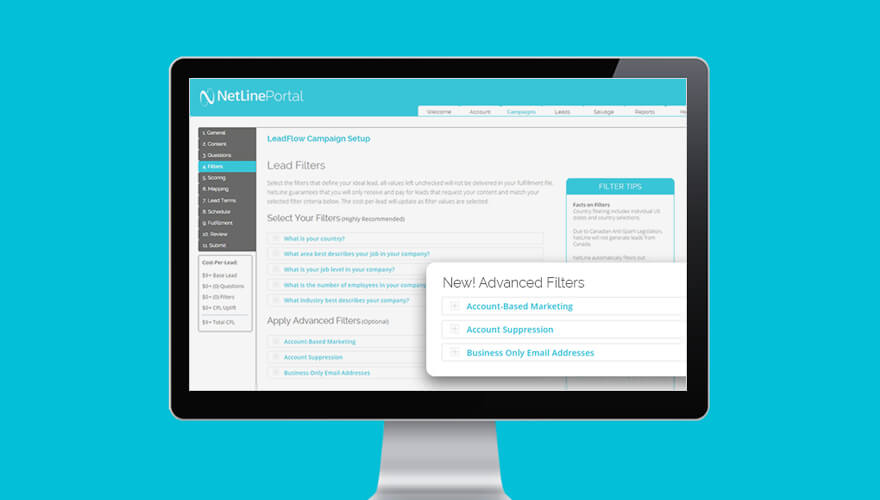
NetLine claims to be the first marketing technology provider to offer self-service account-based marketing (ABM) capabilities directly within their content syndication lead generation portal for B2B marketers
15 June 2017 · ABM & Demand Generation

The B2B website is having a renaissance. While many large companies have struggled to find the role of the website in their ever increasing landscape of digital touchpoints, the maturation of artificial intelligence (AI) and machine learning is changing this trend. Rather than simply showcasing products and services in the form of a digital catalogue, which has been the traditional ‘inside-out’ viewpoint to B2B websites, corporate brands must now understand the value of being relevant to the customer and their needs, how to speak their language, and resonate with their emotional triggers – which conversely means adopting an ‘outside-in’ approach to incorporating data, insights and technology. To stay relevant, the websites must keep the customer up to date on the latest trends and correlations that shape their markets and, inevitably, their bottom line. While this can require cutting-edge technology, it's more often the data and insights about the customer needs – and what those infer with regards to enhancing a digital brand experience – that shape the modern website. Incorporating technology, AI and machine learning are all mediums through which a brand can contextualize content to correspond with a phase of their customer’s information journey. If this contextualization is done right, it can dramatically shorten the sales cycle and create tangible business impact.
14 June 2017 · Marketing Operations and Technology (MarTech)