



Articles
News, analysis and expert opinion from B2B Marketing — all in one place.
799 results · page 6 of 34
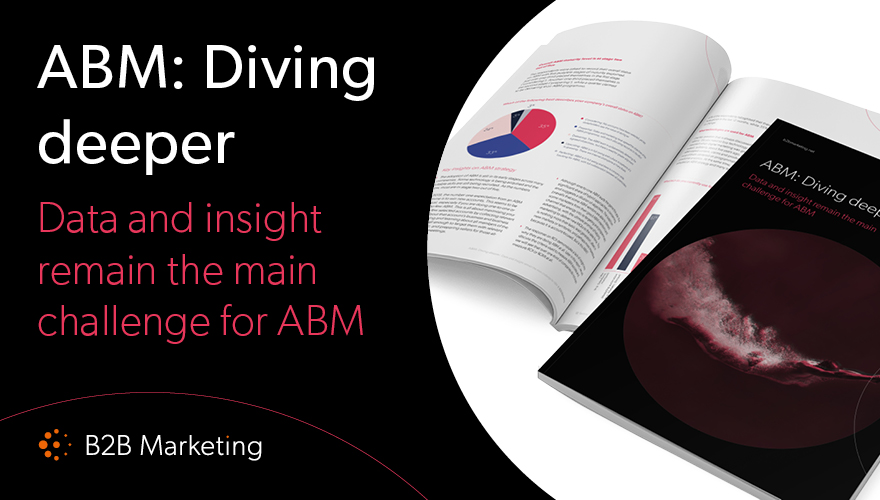
Establishing an ABM strategy
We fielded a series of questions relating to the ABM strategy itself in order to establish the favoured approach, goals and financial impacts in our latest ABM report.ABM is relatively new for most organisations, and it is always about new business.ABM adoption is well established for some companies, with 25% of organisations reporting to have an ABM strategy older than one year. Just 10% of the companies surveyed were professional services organisations. The other early adopters probably include a significant number of technology vendors that also have an important services organisation, or which are providing their technology as a service. For the other three quarters of companies, ABM is clearly a work-in-progress. 27% of companies have been deploying ABM operationally for less than six months, while 36% are still just considering/preparing their programmes. No company plans to cancel their ABM activities in the next 12 months, while a resounding 88% have planned an increase in effort.When asked to rank the main aim of their ABM programme, every respondent selected ‘To win new accounts’ as their number one. Following this, more minor rankings were awarded to: ‘accelerate the sales cycle’, ‘grow existing accounts’ and ‘improve retention’.
25 November 2020 · ABM & Demand Generation

B2B events in 2021: What changes lie ahead?
Helen Coetzee, CEE at MGP & AGNC, spoke at our recent events webinar about what the future of events looks like, and how to make the most of virtual, hybrid and physical events moving forward.Tell us a little bit about your experience of running events in 2020, and how you’ve had to respond to changing circumstancesHC: We didn't have to change our business much. We already had strong skill sets focused on digital and data, which clients really needed to pivot to virtual events and start growing digital revenue streams. Inhouse teams struggled because they tended to have marketing generalists, ops people skilled in physical events, not digital. I've helped clients move events from F2F to online, and also launched some new conferences created for online, with a view to moving F2F when this is possible again.Whether you run your own events, or you invest in third-party events, they are ultimately tools used as part of the wider B2B marketing and sales process. What impact has all this had on wider marketing and sales programmes and activities? HC: There's much more focus on building top of funnel via content-led digital inbound (social, PPC, SEO) and database research, as well as more focus on generating MQLs digitally. Salespeople have struggled to sell if they don't have a lead already almost ready to buy. In addition, there's been more investment in database development, websites, visual branding and messaging.How have buyers responded or reacted to changes, in terms of using events as part of their decision-making processes, or relationship management with suppliers?HC: They're looking for more knowledgeable salespeople to talk to at digital events as part of networking.
23 November 2020 · ABM & Demand Generation
How Capita achieved massive success with ABM
As editor at B2B Marketing, I quite often find myself conducting interviews with the best of the best in the world of B2B. At this year’s ABM Conference, however, Capita’s Kate Owen took the reins and interviewed her colleague Christa Norton, probing into the organisation’s success with ABM.
18 November 2020 · ABM & Demand Generation

Demandbase launches Demandbase One
Account-based marketing platform Demandbase has launched Demandbase One, an ABM service,which incorporates Demandbase and Engagio services.Demandbase One aims to help B2B revenue teams prioritise target accounts, engage across channels and close deals. The service combines proprietary data, third-party data, and a company’s own first-party data to direct teams, teams to accounts that will convert to pipeline and become valuable customers.This new platform comes just five months after Demandbase acquired Engagio. Jon Miller, Chief Product Officer at Demandbase said: “There was very little redundant or overlapping technology that we needed to reconcile. We were able to take the mature Engagio platform, take all the Demandbase technology, and integrate it into that in a way that was very straightforward.”For more information about Demandbase One, visit: www.demandbase.com/products.
17 November 2020 · ABM & Demand Generation

How third-party intent data makes the ABM flipped funnel obsolete
The classic B2B account-based marketing “flipped funnel” turns the traditional marketing funnel on its head. In its simplest form, it focuses on identifying accounts, engaging, expanding, and finally advocating, the stage where your current customers are so loyal, they begin to influence other potential customers. Basically, you work backward, and try to engage a specific set of accounts that fit your ICP (ideal customer profile).This flipped funnel is so prevalent in the ABM world because of its easy explanation and consumable visual representation. It makes sense to marketers, the sales team, as well as the higher-ups who will need to sign off on ABM as a company strategy. And while there’s nothing inherently wrong with the flipped funnel—it is, to a large extent, effective—there’s something in the ABM word pushing it out of the picture: third-party intent data.Generally, intent data helps B2B companies predict when potential customer accounts are ready to buy; this is done with the assistance of omnipresent browser cookies and unique IP addresses. ABM utilizes intent data to select qualified accounts based on the account’s level of research and overall intent to buy. Third-party intent data, versus first-party (which looks at the visits and engagement on your own site), tracks what your accounts or leads are consuming on other websites, outside of your own digital properties. For example, a retail account you’ve been targeting is searching for social media engagement measuring tools, what your company sells, on an industry-specific site; intent data tools (e.g. Bombora, TechTarget) will combine all the data and inform you of their activity interacting with this particular topic. Now, your marketing team knows to aim for deeper content engagement, and your sales team knows this is a target actively looking for this exact kind of product.Here’s where the ABM flipped funnel becomes obsolete: Precise third-party intent data bypasses target accounts who might seem like the perfect fit, but they’re just not at the right stage to buy your product or solution. They might have just purchased a similar tool to what you’re trying to sell; they might be locked into year one of a three-year contract with another company; or maybe they’re going through a reorganization and aren’t ready to bite the bullet. Without intent data, your marketing team will waste money targeting these “ideal” accounts, and your sales team will waste time and effort trying to achieve a sale that will literally never happen—even if they’re working with the best ABM strategy, creative, and targeting in the game.
16 November 2020 · Data and Insights

‘B2B events in 2021: How to meet tomorrow’s challenges’
In a BrightTalk webinar, co-founder and editor-in-chief Joel Harrison spoke with events consultant Carolyn Morgan about the future of physical, hybrid and virtual events, with Covid-19 being very much present going into 2021.Tell us a little bit about your experience of running events in 2020, and how you’ve had to respond to changing circumstances?CM: I’ve had many years of experience in publishing and events businesses, including EMAP and launching my own media conference. I now work with a range of media businesses as a consultant and NED. This year, two clients had to make a quick pivot from in-person events to virtual, and I worked with them to rethink their marketing. Almost every other B2B media business I know is on the same journey.Whether you run your own events, or you invest in third-party events, they are ultimately tools used as part of the wider B2B marketing and sales process. What impact has all this had on wider marketing and sales programmes and activities?CM: B2B brands are the sponsors of most commercial events. There has been a shift in the type of leads generated by virtual events – higher volume but earlier stage, and lighter touch/ less engaged – so requiring more nurturing than those from an in-person event.How have buyers responded or reacted to changes, in terms of using events as part of their decision-making processes, or relationship management with suppliers? CM: Virtual events have perhaps accelerated the move of B2B buyers towards researching purchases in some detail online before approaching a ‘live’ salesperson.Where do you think we are now with B2B events coming towards the end of 2020, looking forward to 2021? What expectations can brands and event organisers have for running/attending events in the next few months?CM: Most corporates are now encouraging their staff to work from home till January 2021 and so it is hard to justify attending an in-person event unless it is really exclusive information or a hard to reach group of people (and Covid-19 safe). Even in January 2021, when we might have a vaccine available, it may take some time until enough of the business population feel safe to attend conferences again. I’m hearing from organisers that they don’t expect to be running large scale (>100) in person events until next summer.
11 November 2020 · ABM & Demand Generation
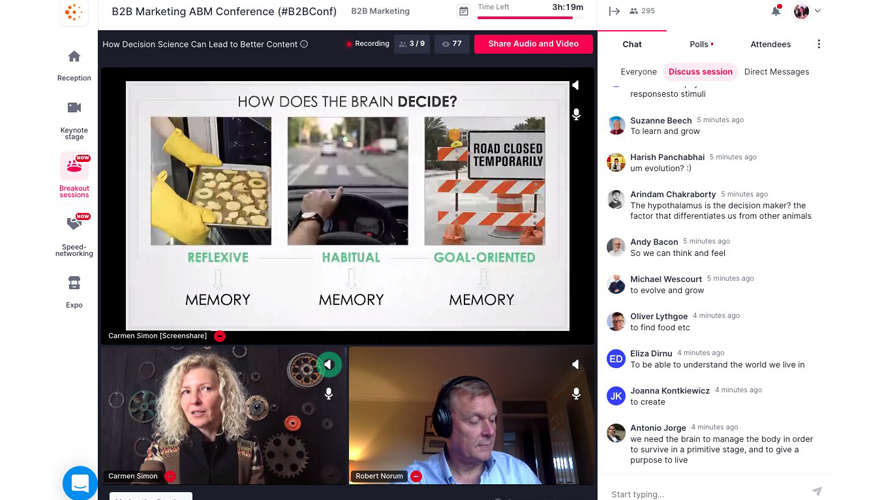
Inside B2B Marketing’s ABM Conference 2020
B2B Marketing hosted its fourth annual ABM Conference on 4–5 November. Held virtually, the event was loaded with presentations on campaigns, data and insights, and technology. Kavita Singh shares the highlights from each streamKeynotes Demandbase’s Paul Gibson gave a compelling keynote about how ABM can help ensure sales and marketing alignment. He also discussed why personalisation wins, why intent is the new lead, and why measuring everything is so vital today.He said: “ABM is proven to perform traditional methods across all of the key areas from the alignment between sales and marketing to increasing the lifetime value overall for your customers.”On Day 2, Chris Wickson held a compelling session on activating omnichannel ABM for better outcomes. He outlined the five steps for precision demand generation: using marketable connected data; connecting channels; using data intelligence; using martech integrations; and utilising insights. He also listed the common pitfalls that marketers need to look out for.These included:Using unmarketable or invalid buyer and account data.Too much technology.Not piloting or testing.Focusing on accounts, not people.Creating silos in your team and organisation.
11 November 2020 · ABM & Demand Generation

How to drive customer engagement in a post-pandemic world
Regardless of industry, product or service, one of the drivers to achieving business success is having a strong customer engagement strategy with which to acquire and retain customers.Due to the ongoing fallout from the pandemic, 2020 has been one of the most challenging years for businesses affected by consumer behaviour and buying habits.The UK is now officially in recession and consumer confidence is historically low. In order to improve and grow, businesses need to focus on what they can do to rebuild and repair customer relationships in these final months of the year ahead and beyond. Part of this involves focusing on relationship building with customers, in an effort to win back spend and loyalty.The challenge for support teamsThe past few months have been a challenge for customer support teams, as they seek to provide the level of attention that customers require, whilst also working effectively from the safety of their own homes. On top of this, the pandemic has caused a multitude of new issues that customers are facing and require support with, as well as of course feeling stressed and anxious about everything that is going on. Combine all of this, and maintaining a positive customer experience starts to seem like an impossible task.This is where improving customer engagement has a powerful role to play: two-thirds of companies compete on the quality of their customer experience and 96% of consumers agree that customer service is key to their purchase decisions. Ramping up customer engagement, therefore, has the potential to pay dividends down the line.
10 November 2020 · ABM & Demand Generation

‘In one word, what’s the key to being a great ABMer?’
And so the ABM Conference is over for another year. But what a conference it was! With streams on sales enablement, technology, data and insight, and content and campaign execution, it's fair to say that there's a lot of things B2B marketers can now actively look to improve on. But, to really break it down into its simplest terms, we recently asked our speakers this question: 'in one word, what's the key to being a great ABMer?'.
5 November 2020 · ABM & Demand Generation

Defining ABM’s new era
On 16 March 2020, a whole era of B2B marketing ended.It was the day the UK announced a nationwide lockdown, and one that had begun with my team finalising one of our most comprehensive ABM programmes yet. It was for Veeam, the market leader in Cloud Data Management, and would have seen us roll out a multi-touchpoint operation that included thought-leading direct mailers, face-to-face sales meetings and an event.
4 November 2020 · ABM & Demand Generation

B2B Marketing Roundtable: Approaching ABM amid Covid-19
During our latest roundtable, we asked where marketers are at in their ABM journeys, and how these might be affected by the pandemic. Kavita Singh shares the highlights.Account-based marketing (ABM) has always been coined as a long-term strategy. However, Covid-19 has presented a number of obstacles. B2B Marketing’s ABM experts Andy Bacon and Robert Norum recently hosted a roundtable discussion in which B2B marketers sharedtheir thoughts on the challenges they have faced, along with some of the processes they’ve implemented over the past few months.Identifying what ABM truly isIf you were to ask 10 different people what ABM is to them, you would get 10 different answers, because every business adapts ABM accordingly. Marketers brought this point up early on in the roundtable.One marketer commented: “Getting a clear definition of what ABM is in your organisation is absolutely a critical starting place because so many companies I work with start with the best intentions, but, as time goes on, it becomes clear that everybody has a fundamentally different understanding of what they mean by ABM.”While it’s okay to tailor the definition of ABM to fit with your business, everyone in the company should be on the same page. While there is no universally accepted definition of ABM, defining what ABM is across the board should be the number one priority before you get started.
13 October 2020 · ABM & Demand Generation

ABM survey deadline fast approaching: What’s in it for you?
With the ABM Conference 2020 fast approaching, that means one thing: our annual ABM report is on its way.Each year, we survey hundreds of B2B marketers on the current state of ABM, and where it’s heading. The results are analysed by our expert analyst, and used to build an in-depth report on the state of ABM.This year, our survey asks you:What is the main aim of your ABM programme?What percentage of your marketing budget do you allocate to ABM?Which of the following best describes your efforts to define your target accounts?And more.The results of this survey will be presented and discussed in full by analyst Peter O’Neill at the ABM Conference. If you’d like to be a part of this year’s survey, click here.In return for completing this survey, you’ll receive a digital copy of the finished ABM report. You’ll also be entered into a prize draw to win one of five pairs of Premium passes to the virtual ABM Conference on 4–5 November. As if that wasn’t enough, one participant will also win a Razer Kiyo professional webcam (worth £100).Please note that the deadline for completing the survey is Thursday 16 October, so what are you waiting for? Take part now!
13 October 2020 · ABM & Demand Generation

Why creating a successful account-based marketing programme is more important than ever
In recent years, ABM (account-based marketing) has been steadily rising as a business marketing strategy. Also sometimes referred to as key account marketing, ABM is a focused strategic approach to business marketing that is especially useful for business-to-business (B2B) companies. It operates on a “quality versus quantity” principle, choosing to target fewer but higher quality accounts rather than producing large quantities of leads and turning them into customers.However, only 11% of B2B marketing teams actually have a fully developed and established ABM plan in action. This guide will give you an introduction to the hows and whys of ABM as well as the best steps to creating a successful ABM programme, particularly for marketing teams from B2B companies.Why should you use ABM In business?In many ways, ABM is also a collaboration between the sales and the marketing team. Although the marketing team does understand the target demographics, the sales team is more knowledgeable about specific details since it gets to interact with the market directly. In fact, only 28% of salespeople considered marketing as the best source for leads, while an even smaller percentage of 7% viewed those leads as high quality. In other words, based on the company’s existing customer profiles, both teams will have to coordinate to target and engage a handful of accounts that will best fit the company’s products and services. And since many business-to-business (B2B) companies manufacture their products or conduct their services towards their clients’ businesses, having only a few targeted clients has the potential to be more beneficial than raking in a lot of clients with minimal work.
12 October 2020 · ABM & Demand Generation

Rebranding ABM to ABE – embedding a global discipline
Last year I found myself standing in front of our global sales leadership, ready to present on Account-Based Marketing (ABM). To me, ABM was a critical approach that we needed to implement across our most important customer accounts. However, to my audience it was just another new acronym that failed to resonate, as from the outset there was an assumption that this was purely a marketing initiative and didn’t impact the sales teams or our customers in a meaningful way.I thought to myself ‘how can they not understand the magic that is ABM?’.Position effectivelyI needed to put myself in their shoes, and after a short amount of deliberation, I decided to rebrand ABM to ABE (Account-Based Engagement) and once again, I took the concept on the road to get the senior buy in and support I needed to implement effectively across the organization.This time I clearly outlined the cross-functional nature of ABE, focusing on how we needed to come together to provide a differentiated customer experience for our largest accounts. This time it worked!Fast forward a year, with a global pandemic and the sharpest disruption to marketing strategy we’ve ever seen, the team have now delivered comprehensive ABE plans for 50+ accounts globally, based across all regions including the United States, United Kingdom, France, Switzerland, Germany, Japan, Australia and Singapore.So how did we go about doing this?
29 September 2020 · ABM & Demand Generation

B2B events: No let up in fast & furious transformation
Events were the B2B marketing discipline that changed fastest and furthest in the wake of the first wave of Covid19, with investment in digital rocketing as physical events became unviable. But as attendees to our recent B2B Marketing leaders roundtable testified, this change has far reaching implications and (if anything) is continuing to accelerate as the pandemic deepens
23 September 2020 · ABM & Demand Generation

Demand generation in the far future
Making predictions more than 10 years away is tricky, but as with developments over the previous decade, demand gen will look radically different to how it does now The end of demand generation as we know it In its current high-volume, mass-marketing form, demand generation is simply not sustainable for the next 10 years. The shrinking audience, lack of engagement and tighter privacy restrictions will render it untenable. The rapid rise in the popularity of account-based marketing over the past few years is a direct reaction to this as marketers search for a fresh alternative that will allow them to steal a march on their competitors. While the excitement and hype around ABM will undoubtedly die down, the method itself is here to stay. A characteristic of successful account-based marketing is a full commitment to the strategy, and for organizations with limited marketing resources this might mean dialing back on demand gen activity. This is what happened at Fujistu when the company went all-in on ABM a few years ago. As head of ABM, Andrea Clatworthy told the B2B Marketing ABM Conference in 2017: “We had to stop doing some stuff to give people the space to do ABM. So we stopped demand gen, we stopped lead gen – the business didn’t notice for a year.” Most companies won’t have the luxury of just switching demand gen off; it’s likely companies will operate some form of hybrid model with a combination of one-to-one/ one-to-few ABM, and one-to-many (or programmatic) ABM replacing the demand gen of today.Programmatic ABM is powered by technology, its popularity is also likely to grow as the martech behind it becomes more powerful. Advanced artificial intelligence and machine learning will support smarter prospecting, better lead qualification, and much stronger personalisation through content, products and support.No silver bullet, but multi-touch attribution will get easier Attribution modelling in the complex customer journey remains a headache, and unfortunately there is no foreseeable silver bullet to deliver a 100% accurate map of how marketing has influenced a sale. It should at least get easier. Collating data from a variety of systems that aren’t integrated can be a slow and laborious process. Consolidation among martech vendors, such as Adobe’s acquisition of Marketo (which owns Bizible) should mean systems can trade data with each other more easily, giving a more complete picture of the customer journey. Other technology improvements will support the collection of touchpoint data. One reason brands currently invest in airport ads, is that they’re worried what might happen if they don’t. Soon they will have clear metrics for why. “It won’t be long before a brand can link up the fact that I’ve walked through Heathrow, seen their adverts, and become a customer,” says Peter Morgan. “Even if we’re getting a bit more data about why an organisation is increasing its spending, that’ll put us in a much better place than we are now.”
14 September 2020 · ABM & Demand Generation

10 things to avoid getting wrong in account-based marketing
Today’s blog is essentially a distillation of the 10 key take outs from my ABM Essentials course for B2B Marketing, although on the advice of David McGuire, one of my faculty colleagues, I’ve opted to call it the ‘10 things to avoid getting wrong’ because apparently we all prefer reading about how to avoid getting things wrong rather than about recommendations on how get things right. Curious but true.Get the following right and not much will go wrong as you launch or refine your ABM programmes.A clear definition of ABM in your organisation.Don’t start your ABM programme without having a clear definition of what ABM actually is within your organisation. Make sure you have developed it with all your key stakeholders and that everyone has signed it off. There are too many interpretations of ABM for this to be left to chance.Executive sponsorship is vitalMake sure that you have support for your ABM programme from the top down. At the very least the regional heads of sales and marketing, ideally the CMO and CRO, and potentially even the CEO. Your ABM activities will go much more smoothly if ABM thinking is cascading down and through the organization. And when the going gets tough (as it probably will at times), you will have the support you to need to drive on through.Sales & Marketing alignment is not an optional extraIf you want a successful ABM programme it is essential that sales & marketing are both signed up and 100% committed. ABM is not a service that marketing performs for sales, it is a joint effort and requires sustained focus and commitment from both teams for it to work effectively.
14 September 2020 · ABM & Demand Generation
Q&A with Leaders Forum keynote speaker, Joe Ippolito, IBM
With the B2B Marketing Leaders Forum fast approaching, David Rowlands caught up with keynote speaker Joe Ippolito to discuss his presentation, Covid-19 and his tips for marketing leaders over the coming months.Joe is head of transformation analytics, data & performance marketing at IBM, and will be delivering his presentation ‘You are not a marketer’ at 3:20-4:00 p.m. BST on 10 September. For the full Leaders Forum agenda, click here.
7 September 2020 · ABM & Demand Generation

Q&A with Mark Larwood, head of ABM and advocacy marketing, O2
David Rowlands recently caught up with Mark Larwood, head of ABM and advocacy marketing at O2, to discuss the challenges we have all faced in 2020, what will set leaders apart from the rest in the coming months, and the importance of account-based marketing.
3 September 2020 · ABM & Demand Generation

An interview with Rossa Shanks
We recently caught up with Rossa Shanks, CMO at Dow Jones, to discuss his current role and marketing challenge, his new book dedicated to ABM, and his advice for anyone undertaking ABM programmes in this new post-Covid world.Tell us a bit about you, and your background. How do you think this prepares you for your current role?My career so far has been eclectic but thematically consistent because I love creating stuff. I started my career at creative ad agencies, AMV BBDO and Grey London, working across many different brands, from Mercedes Benz and BT to The Economist and PepsiCo. It was a lot of fun creating TV ads and integrated ad campaigns.At Grey London, we pitched and won the News UK account. Six months later, the CMO of News UK poached me and I switched gears to B2C client-side marketing. Advertising is such a small slice of the marketing pie, so it was a great opportunity to take on a new learning curve. However, at the time, I had an entrepreneurial itch. So, it wasn’t long before I left to start my own business with a friend from the advertising industry. It was called Great Little Place — a user-generated little black book of the most charming places to go. I was CEO but, in reality, I spent a lot of my time as the de facto CMO because we were a small team.I believe start-up marketing is a discipline in and of itself. Building a company from the ground up requires imagination, grit and tenacity. So, I educated myself and read about viral loops and growth hacking and turned my hand to that. As a result, we grew our community to over 1.5 million fans on social media and managed to attract 110,000 founding members’ email addresses before debuting on the app store and being featured as Apple’s No. 1 app of the week.Working in the start-up world is a great adventure but, in the end, my corporate roots came calling again. The former CMO of News UK, who had previously hired me, had moved on to become president of Dow Jones in New York. So, when the call came to become CMO of Dow Jones across the pond four years ago, I couldn’t say no. It’s at that point that I had to learn B2B marketing from scratch whilst building out a whole new team.
17 August 2020 · ABM & Demand Generation

Recent B2B trends for brands to take advantage of
We are seeing several consistent trends that have emerged in recent years and are now being accelerated as a result of businesses and marketers adapting rapidly to a new business landscape and future of work as we know it. Specifically; Content: We are seeing a greater breadth of content delivered across multiple touchpoints. While quantity isn’t key – too much isn’t necessarily a good thing – the increase in engaging formats such as audio, podcasts and live digital experiences have never been more important. Traditionally perceived as dry, B2B content is now focussed on delivering innovative material and insight that drives a connection and engages audiences on a human level. B2B brands should be thinking about authenticity, providing help where they have credibility and being humble and human to achieve cut-through in a new era.Connection: Given this consistent cry for more human content, B2B comms are evolving, as brands recognise that business decisions are made by people, not organisations, which drives the need to interact with the individual and acknowledge their emotions and personal habits and preferences. This is reinforced by the changing and increasingly complex nature of the C-suite; as well as the traditional audience, we should be looking to engage younger, more diverse and digitally-focused decision-makers, the business leaders of today and tomorrow.Account-based marketing: The highly-focused nature of ABM benefits from increasing levels of data and indicators available, such as content consumption and digital signals. It is becoming increasingly intuitive and smart, with intent indicators used to demonstrate more intelligently where to take a more dedicated approach. An initial communication to top prospects, for example, can be honed down to target only those that engage, with online behaviour allowing one-to-one marketing and super-focused messaging (provided it’s helpful and human of course).
10 August 2020 · ABM & Demand Generation

Who to target in a post-Covid world: It’s time to review your priorities
In the post-Covid world, making sure you prioritise which prospects and customers you focus on is crucial to your organisation’s success. At Ignite London, Chris Ashley-Manns and Charlie Nicholson outlined their ABM process to help you do this, and highlighted some key considerations that need to be taken into account. This article is just one of many ABM-focused pieces that will feature in our upcoming Summer 2020 issue of B2B Marketing magazine.
3 August 2020 · ABM & Demand Generation

The top ABM opinion formers and influencers
Account-based marketing (ABM) has become a core part of the B2B marketing firmament, with a growing number of brands using it to drive excellent results, and with best practice development led by cluster of pioneers and experts. So who are these ABM leaders?We’ll be unveiling this list in our summer 2020 magazine, and we’re looking for nominations now! If you’d like to nominate someone, here’s how to do it…
15 July 2020 · ABM & Demand Generation

The near future of demand generation
Demand gen will need to become more strategic in the next two to five years as buyers demand a more personalised customer journey.Demand generation will be perceived as more strategic A few years ago, the title ‘head of demand generation’ may have seemed unusual. Now it’s a common role among even mid-size businesses trying to manage their marketing activity. Demand generation has traditionally been perceived as a tactical activity. As such it doesn’t have a high profile, and is often considered low skilled and is even outsourced to low cost locations when done at scale. In the future, firms will have to think of it more strategically. That’ll mean placing more importance on it, and investing more in it. Demand gen has traditionally been seen as a low-value, tactical pursuit, but a high volume blitz won’t be viable in the future. As multinationals merge and consolidate at the top of the market, the number of vital decision-makers to reach is getting smaller, and the majority of organisations are employing third-party resource, internal sales or business development teams after this diminishing set of targets. The demand generation marketers of two to five years’ time will need to be much smarter in their approach. This will require organisations to change their mindset away from the game of chasing high-volume numbers. Individuals will need to be upskilled to provide the level of account insight necessary for these smaller audiences.
13 July 2020 · ABM & Demand Generation


