



Articles
News, analysis and expert opinion from B2B Marketing — all in one place.
12,867 results · page 63 of 537

Episode 12: ABM with Mark Larwood of O2
In this week's episode, B2B Marketing's Joel Harrison sits down with Mark Larwood to discuss all things ABM. Leading up to our ABM Conference 2020, they get into how ABM plays a role in the B2B world today, especially during the Coronavirus.Tell us about your background – when did you become a marketer? Was it something that you always wanted to do? Or was it something that you stumbled into?Growing up I wanted to be many things from a pilot, to doctor to lawyer, but I don’t remember it ever being B2B marketer though. From a very early age, I was more fascinated with TV adverts than with TV programmes – which maybe says more about 1980s children’s TV than anything else, but I like to think that laid the seed for marketing in my head.Then I went to university, studied business and languages and realised I liked marketing more than economics, liked behavioural science and psychology more than statistics… And so I went out to find a job in marketing. I joined a small tech firm and kind of fell into B2B. But now I wouldn’t want to be anywhere else!
27 November 2020 · ABM & Demand Generation

A practical guide to building B2B buyer personas
Buyer personas are actionable representations of the roles involved in buying and using your product. While sometimes overlooked, building personas is a critical step in your strategy to successfully engage prospects. While some prefer the term “customer personas”, the labels may be interchangeable as long as the focus remains documenting who they are, what they do, challenges they face, and relevant behaviours. When are personas developed? Personas provide meaningful detail beyond the information documented in segmentation. Using CRM terminology, segmentation identifies the right accounts and personas comprise your contacts. In the real world, persona building is an art form as much as a science. It is rare to be able to purchase a report with all the information you need, so be creative.How to capture the right informationStart with secondary data to gain a baseline of intelligence. Analyst reports, blogs, competitors’ publications, product reviews, social media, and thought leadership are good sources. I once found a blog from an industry influencer outlining who facilities managers report to in hospitals. I was curious why someone would publish this, but it was precisely what I needed to map out organisational structure. Many analysts will do informational calls as well to augment published work. With your foundation in place, tap into your network for informational interviews. When you ask, be sure to clarify that this is purely a market research initiative and not a pitch. Encourage them to be as candid as possible and be open to raw feedback. Better to have assumptions shot down before spending money on a product launch. TIP: Involve key stakeholders early. Sales, support, and others offer vital customer information and alignment is important because your efforts may fall fflat without buy-in. When I met a contact for lunch who fit our initial profile of a c-level decision-maker in the right market, I invited the sales director. I explained to both parties the purpose was not to sell anything but to delve into the customer’s expertise. Ultimately, the meeting was fruitful on multiple levels. The interviewee articulated why his segment would never buy but provided invaluable insights on who we should be targeting and why.
26 November 2020 · Content, Creative & Campaigns

Anker Innovations selects Widen to enhance digital asset management globally
Anker Innovations has chosen Widen for its digital asset management services to help employees worldwide.Anker Innovation provides wireless and car charging services as well as portable and wall-mounted chargers using ‘PowerIQ’ technology to charge laptops, tablets and other devices at the fastest speeds possible. Anker Innovation aims to implement Widen’s services to help manage and distribute its extensive range of digital assets, including videos and images. Widen’s services will also enable marketing and sales teams to access content more efficiently.Widen’s software enables brands to plan, create, manage, publish, and analyse content across channels. It also helps marketing teams to be efficient, agile, and focused in their efforts to build brands and connect with audiences. Most recently in October, Widen was named Best Digital Asset Management Platform in Martech Breakthrough Awards 2020. Jake Athey, VP Marketing and Customer Experience, Widen, said: “For large, multinational organisations such as Anker Innovations, DAM is crucial in empowering teams not just in terms of consistency, but in proving ROI. Not only can they find content they need, when they need it, but they can make the content work harder and smarter by reusing, replicating, and adapting assets, rather than creating new ones from scratch. Moreover, by using a DAM system, companies can automate and accelerate workflows, and deliver measurable results through performance metrics, indicating which assets perform best. One thing we’ve also heard from many customers throughout this year is that having a DAM system in place has enabled them to keep pace with content demands, despite being remote. Not only has it sustained processes across dispersed teams, but it has kept content consistent across channels and time zones by having that central source to pull from.”
26 November 2020 · Content, Creative & Campaigns
Establishing an ABM strategy
We fielded a series of questions relating to the ABM strategy itself in order to establish the favoured approach, goals and financial impacts in our latest ABM report.ABM is relatively new for most organisations, and it is always about new business.ABM adoption is well established for some companies, with 25% of organisations reporting to have an ABM strategy older than one year. Just 10% of the companies surveyed were professional services organisations. The other early adopters probably include a significant number of technology vendors that also have an important services organisation, or which are providing their technology as a service. For the other three quarters of companies, ABM is clearly a work-in-progress. 27% of companies have been deploying ABM operationally for less than six months, while 36% are still just considering/preparing their programmes. No company plans to cancel their ABM activities in the next 12 months, while a resounding 88% have planned an increase in effort.When asked to rank the main aim of their ABM programme, every respondent selected ‘To win new accounts’ as their number one. Following this, more minor rankings were awarded to: ‘accelerate the sales cycle’, ‘grow existing accounts’ and ‘improve retention’.
25 November 2020 · ABM & Demand Generation

HubSpot and Howard University partner for Center of Digital Business
The Howard University School of Business has announced the launch of Howard University’s first Center for Digital Business, created with support of a donation from CRM platform, Hubspot. The donation will support the creation and management of the Center for Digital Business as well as educational offerings for the next five years. Howard University has been a premier institute for higher education within the Historically Black Colleges and University (HBCU) circuit, especially within the school of business. The Center for Digital Business will provide a multipurpose space within the School of Business to help students further in collaboration and innovation. The Center will focus on three key areas for programming including, academic offerings, experiential learning opportunities and support for job readiness.The School of Business is set to offer for-credit courses through the Center in the Spring 2021 semester. Andrew Lindsay, SVP of corporate business development at HubSpot said: “HubSpot and Howard University have a long-standing relationship that has included on-campus recruiting efforts and partnering in HubSpot’s Education Partner Programme. We value our relationship with Howard University tremendously and are excited to expand it. As a proud alumnus of Howard, HubSpot’s support to create a new Center for Digital Business is incredibly personal. At HubSpot, we feel that it’s vital for leading businesses to play an active role in the development of the next generation of Black business leaders, and this Center is just one key component of our commitment.”
24 November 2020 · People, Teams and Skills

B2B events in 2021: What changes lie ahead?
Helen Coetzee, CEE at MGP & AGNC, spoke at our recent events webinar about what the future of events looks like, and how to make the most of virtual, hybrid and physical events moving forward.Tell us a little bit about your experience of running events in 2020, and how you’ve had to respond to changing circumstancesHC: We didn't have to change our business much. We already had strong skill sets focused on digital and data, which clients really needed to pivot to virtual events and start growing digital revenue streams. Inhouse teams struggled because they tended to have marketing generalists, ops people skilled in physical events, not digital. I've helped clients move events from F2F to online, and also launched some new conferences created for online, with a view to moving F2F when this is possible again.Whether you run your own events, or you invest in third-party events, they are ultimately tools used as part of the wider B2B marketing and sales process. What impact has all this had on wider marketing and sales programmes and activities? HC: There's much more focus on building top of funnel via content-led digital inbound (social, PPC, SEO) and database research, as well as more focus on generating MQLs digitally. Salespeople have struggled to sell if they don't have a lead already almost ready to buy. In addition, there's been more investment in database development, websites, visual branding and messaging.How have buyers responded or reacted to changes, in terms of using events as part of their decision-making processes, or relationship management with suppliers?HC: They're looking for more knowledgeable salespeople to talk to at digital events as part of networking.
23 November 2020 · ABM & Demand Generation

Top 4 marketing channels for B2B brand awareness in 2021
If B2B marketing campaigns were board games, the awareness stage of the sales funnel would begin at the “start” space and last well into the first few turns. As an experienced player (or marketer) will tell you, it’s here where your initial moves can make all the difference in performance. How well you do at this point can be the reason you win (i.e. sign a new client) or the explanation for why you came second place. Can you still win if you don’t blow away the competition at this stage? Yes, but it’s going to be a lot more difficult to get ahead down the line.Now think of digital marketing channels like the direction cards or rolls of the dice: They get you where you need to be. So if you want to move forward in the B2B marketing game, you need to utilize the best, most efficient channels to achieve your overall goal of brand awareness. But in the 2021 version of the B2B marketing game, some channels have changed. As we saw with COVID-19’s initial impact in March 2020, B2B companies have had to remain nimble; digital channels that worked to achieve awareness in the past might not be as effectual anymore. “Companies have been forced to look at digital channels and communication techniques that they did not use previously,” says Brian Giese, CEO at True Influence.So which paths should B2B companies take to reach brand awareness among targeted accounts next year? Which channels will result in the most efficient spends and highest returns? While most marketing channels can (and should) be utilized throughout all stages of the sales funnel—including consideration, validation, and evaluation—there are a few that stand out as the winners of 2021. These are the channels B2B marketing teams should focus their efforts on in order to increase organic traffic, blog visits, and engagement over the next 12 months.
23 November 2020 · Content, Creative & Campaigns

Gravity reinforces global aspirations with acquisition of B2B digital specialists Nurture
The Board of Gravity Global have confirmed the acquisition of the digital agency Nurture. Gravity aims to further strengthen its digital transformation capabilities with this acquisition. It is the latest in a series of acquisitions completed by Gravity in recent months as part of a growth strategy both in the UK and internationally.Based in London and Poland with 97 employees, Nurture creates customer-centric digital experiences across a full spectrum of martech platforms. Mark Lethbridge (middle in picture above), chief executive of Gravity Global said the group’s strategy is to create the world’s most admired digitally-led marketing consultancy, with a core focus on complex markets, capable of supporting fast growth brands digital adoption and optimisation in any market they serve.Mark said: “Gravity is proud of the fact it is described as the world’s most awarded consultancy across the full marketing spectrum from brand development to demand generation. Most businesses understand that the marketing battleground is now won and lost in the digital world. Covid-19 has amplified this situation. Yet, brands still struggle with achieving high performance from digital activities. Every brand is expanding their digital marketing efforts but few are doing it well. This is why we have built the complete digital value chain at Gravity, tapping into the demand for digital transformation.”Nurture will rebrand to ‘Gravity Global - Digital as a Service’ by the end of the year.
20 November 2020 · People, Teams and Skills

EI’s Go-To-Market Strategy Barometer 2020
Since the onset of the Covid-19 pandemic, marketers have been constantly challenged on many fronts, and have had to pivot quickly in redirecting their efforts around new business pressures. The uncertainty during this period combined with industry volatility meant that many marketers had to brave the storm alone.
19 November 2020 · Go-To-Market
How Capita achieved massive success with ABM
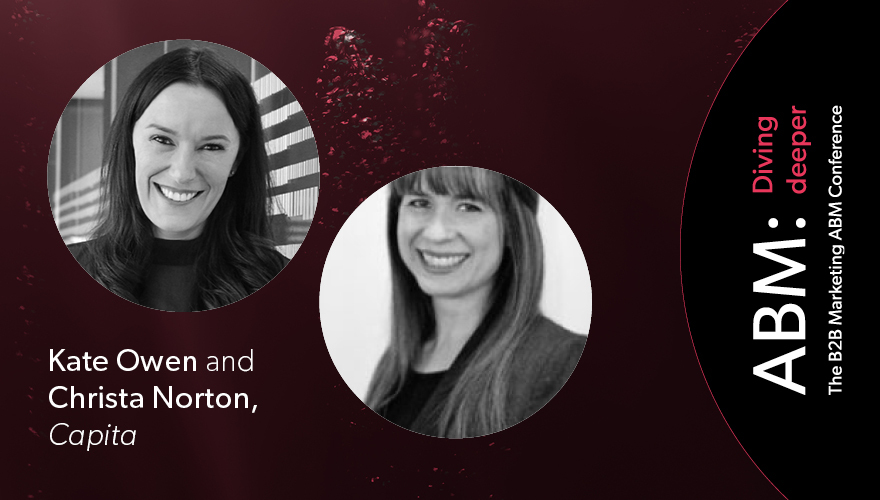
As editor at B2B Marketing, I quite often find myself conducting interviews with the best of the best in the world of B2B. At this year’s ABM Conference, however, Capita’s Kate Owen took the reins and interviewed her colleague Christa Norton, probing into the organisation’s success with ABM.
18 November 2020 · ABM & Demand Generation

Chris Schermer elected chairman of Magnet Global Agency Network
Chris Schermer, president of B2B marketing firm Schermer, has been elected chairman of the board of marketing and advertising global network Magnet.Schermer has been a Magnet member since 2014, and Chris has served on Magnet’s board of directors since 2018, leading the network’s branding and website. Magnet collectively boasts capitalised billings of $2 billion annually and consists of 38 independently owned agencies spanning six continents.As board chair, he will work closely with Magnet CEO Melissa Lentz to help make their agencies individually better and the network organisationally stronger. Schermer believes Magnet membership has been very beneficial to his agency, employees and clients.Chris said: “It’s been a breath of fresh air to have joined this group after nearly 20 years in business. As an independent owner, I was seeking peers who would both challenge and support me as a leader. They’re my partners in a sense, helping to prepare me and Schermer for what’s ahead. As the Network’s chair, I’ll get the chance to do the same for the Magnet.”
18 November 2020 · People, Teams and Skills

How micro-segmenting customer data can meet increasing customer demands and increase conversions
Every good B2B marketer knows that having a deep understanding of your customers is key to selling effectively. Nothing can replace the human-to-human connection when you’re trying to connect with your core audience.However, a great amount of insight about your customers can be gained using data alone. Analysing and exploiting data delivers customer value by supercharging your content strategy. Microsegmentation is the key word for marketers and data analysts here. It’s where customers are divided into segments based on traditional or broad groups, and mostly based on factors such as geography, company size and industry. Finding ways to further break down categories into micro segments based on demographics, buying behaviours, psychographic, and geographic factors is key to success in marketing. In this article, we will discuss how micro segmentation can take your marketing strategy to the next level, proving to your clients and leads that you truly “get it” when it comes to their needs. We will also talk about how AI and data analysis are key to finding patterns and micro segments that allow you to create high-quality, targeted content for your prospects that will increase sales conversion.
17 November 2020 · Data and Insights

Demandbase launches Demandbase One
Account-based marketing platform Demandbase has launched Demandbase One, an ABM service,which incorporates Demandbase and Engagio services.Demandbase One aims to help B2B revenue teams prioritise target accounts, engage across channels and close deals. The service combines proprietary data, third-party data, and a company’s own first-party data to direct teams, teams to accounts that will convert to pipeline and become valuable customers.This new platform comes just five months after Demandbase acquired Engagio. Jon Miller, Chief Product Officer at Demandbase said: “There was very little redundant or overlapping technology that we needed to reconcile. We were able to take the mature Engagio platform, take all the Demandbase technology, and integrate it into that in a way that was very straightforward.”For more information about Demandbase One, visit: www.demandbase.com/products.
17 November 2020 · ABM & Demand Generation

How third-party intent data makes the ABM flipped funnel obsolete
The classic B2B account-based marketing “flipped funnel” turns the traditional marketing funnel on its head. In its simplest form, it focuses on identifying accounts, engaging, expanding, and finally advocating, the stage where your current customers are so loyal, they begin to influence other potential customers. Basically, you work backward, and try to engage a specific set of accounts that fit your ICP (ideal customer profile).This flipped funnel is so prevalent in the ABM world because of its easy explanation and consumable visual representation. It makes sense to marketers, the sales team, as well as the higher-ups who will need to sign off on ABM as a company strategy. And while there’s nothing inherently wrong with the flipped funnel—it is, to a large extent, effective—there’s something in the ABM word pushing it out of the picture: third-party intent data.Generally, intent data helps B2B companies predict when potential customer accounts are ready to buy; this is done with the assistance of omnipresent browser cookies and unique IP addresses. ABM utilizes intent data to select qualified accounts based on the account’s level of research and overall intent to buy. Third-party intent data, versus first-party (which looks at the visits and engagement on your own site), tracks what your accounts or leads are consuming on other websites, outside of your own digital properties. For example, a retail account you’ve been targeting is searching for social media engagement measuring tools, what your company sells, on an industry-specific site; intent data tools (e.g. Bombora, TechTarget) will combine all the data and inform you of their activity interacting with this particular topic. Now, your marketing team knows to aim for deeper content engagement, and your sales team knows this is a target actively looking for this exact kind of product.Here’s where the ABM flipped funnel becomes obsolete: Precise third-party intent data bypasses target accounts who might seem like the perfect fit, but they’re just not at the right stage to buy your product or solution. They might have just purchased a similar tool to what you’re trying to sell; they might be locked into year one of a three-year contract with another company; or maybe they’re going through a reorganization and aren’t ready to bite the bullet. Without intent data, your marketing team will waste money targeting these “ideal” accounts, and your sales team will waste time and effort trying to achieve a sale that will literally never happen—even if they’re working with the best ABM strategy, creative, and targeting in the game.
16 November 2020 · Data and Insights

Challenging times for marketing leaders
Now more than ever, the backdrop for any marketing leader is muddied. With marketing leaders ideally positioned to respond to changing customer needs, not all have the skills required. Repeated surveys and workforce confidence indices point to a lack of confidence in careers in advertising and media. So, what is the answer? Read on to find out more.Essential skills put to the testDealing with a crisis that ebbs and flows creates a great amount of uncertainty and marketing isn’t necessarily the department an organisation looks toward to navigate it. Whereas the CMO or Marketing Director should be the driver of growth, not all marketing teams can tie their activities to return. As a result, the CFO or Finance Director is the most common role thrust into the spotlight in a crisis and marketing an area that feels the heat.But what skills do marketing leaders possess? The answer is varied and diverse. Creative visionaries that dazzle onlookers with their creations. Innovators that pursue the latest technological marvels display a talent for a digital world. Customer-centric marketers that think like a customer and craft compelling customer journeys and inspire stakeholders. There are many skills that stand these leading lights of marketing in good stead that are stress-tested when times are hard.Marketing leaders face a quandaryAs we know, many marketing leaders like to follow the latest trends, diving into the hottest new social media channel or software. The very core of marketing is to promote a brand and its products or services. Tough competition means that getting there first or setting a trend gives a temporary advantage to marketing efforts.Unfortunately, CMOs face a quandary when they are no longer able to invest in the shiny new thing. Instead, the reality may be restricted budgets, going cap in hand to the CFO to sign off every PO or even changing their LinkedIn status to ‘available to work’. This landscape requires a different set of skills that not all marketers possess or hold to varying degrees.
16 November 2020 · People, Teams and Skills

Interview with Martin Simcock, Enigma founder
Following the news that Enigma has been acquired by JUST, David Rowlands caught up with Enigma founder Martin Simcock to discuss the challenges and opportunities that lie ahead for newly-formed Just Global.
13 November 2020 · Content, Creative & Campaigns

JUST and Enigma launch Just Global
US-based JUST has acquired internationally-stationed Enigma Marketing to create a new, independent, global and full-service agency: Just Global.
12 November 2020 · Content, Creative & Campaigns

‘B2B events in 2021: How to meet tomorrow’s challenges’
In a BrightTalk webinar, co-founder and editor-in-chief Joel Harrison spoke with events consultant Carolyn Morgan about the future of physical, hybrid and virtual events, with Covid-19 being very much present going into 2021.Tell us a little bit about your experience of running events in 2020, and how you’ve had to respond to changing circumstances?CM: I’ve had many years of experience in publishing and events businesses, including EMAP and launching my own media conference. I now work with a range of media businesses as a consultant and NED. This year, two clients had to make a quick pivot from in-person events to virtual, and I worked with them to rethink their marketing. Almost every other B2B media business I know is on the same journey.Whether you run your own events, or you invest in third-party events, they are ultimately tools used as part of the wider B2B marketing and sales process. What impact has all this had on wider marketing and sales programmes and activities?CM: B2B brands are the sponsors of most commercial events. There has been a shift in the type of leads generated by virtual events – higher volume but earlier stage, and lighter touch/ less engaged – so requiring more nurturing than those from an in-person event.How have buyers responded or reacted to changes, in terms of using events as part of their decision-making processes, or relationship management with suppliers? CM: Virtual events have perhaps accelerated the move of B2B buyers towards researching purchases in some detail online before approaching a ‘live’ salesperson.Where do you think we are now with B2B events coming towards the end of 2020, looking forward to 2021? What expectations can brands and event organisers have for running/attending events in the next few months?CM: Most corporates are now encouraging their staff to work from home till January 2021 and so it is hard to justify attending an in-person event unless it is really exclusive information or a hard to reach group of people (and Covid-19 safe). Even in January 2021, when we might have a vaccine available, it may take some time until enough of the business population feel safe to attend conferences again. I’m hearing from organisers that they don’t expect to be running large scale (>100) in person events until next summer.
11 November 2020 · ABM & Demand Generation
Inside B2B Marketing’s ABM Conference 2020
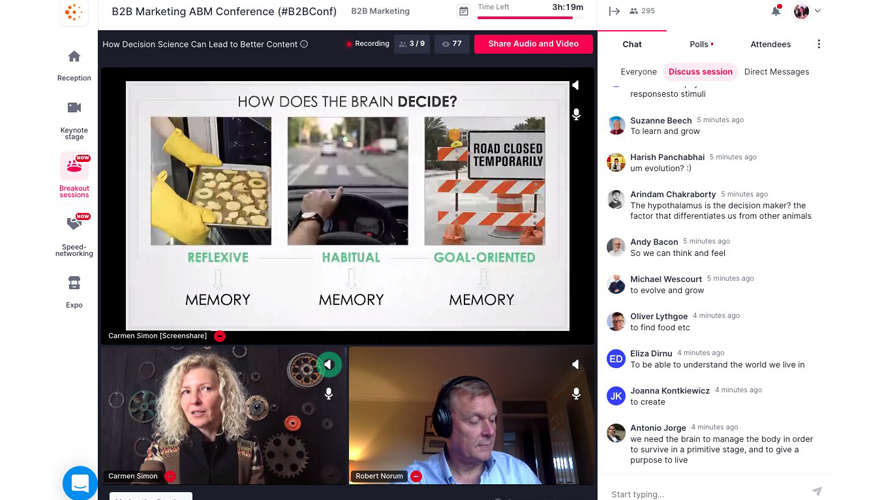
B2B Marketing hosted its fourth annual ABM Conference on 4–5 November. Held virtually, the event was loaded with presentations on campaigns, data and insights, and technology. Kavita Singh shares the highlights from each streamKeynotes Demandbase’s Paul Gibson gave a compelling keynote about how ABM can help ensure sales and marketing alignment. He also discussed why personalisation wins, why intent is the new lead, and why measuring everything is so vital today.He said: “ABM is proven to perform traditional methods across all of the key areas from the alignment between sales and marketing to increasing the lifetime value overall for your customers.”On Day 2, Chris Wickson held a compelling session on activating omnichannel ABM for better outcomes. He outlined the five steps for precision demand generation: using marketable connected data; connecting channels; using data intelligence; using martech integrations; and utilising insights. He also listed the common pitfalls that marketers need to look out for.These included:Using unmarketable or invalid buyer and account data.Too much technology.Not piloting or testing.Focusing on accounts, not people.Creating silos in your team and organisation.
11 November 2020 · ABM & Demand Generation

Adobe to acquire Workfront
Adobe has announced it has agreed to acquire work management platform Workfront, for $1.5 billion, subject to customary purchase price adjustments.The transaction is expected to close during the first quarter of Adobe’s 2021 fiscal year. Until the transaction closes, Adobe and Workfront will continue to run independently. Upon close, Workfront CEO Alex Shootman will continue to lead the Workfront team, reporting to Anil Chakravarthy, executive vice president and general manager, Digital Experience Business and Worldwide Field Operations.The combination of Adobe and Workfront will bring efficiency, collaboration and productivity for marketing teams. Workfront is equipped with APIs which can enable a connection to Adobe Creative Cloud and Adobe Experience Cloud, and can further Adobe’s leadership in customer experience management.Adobe and Workfront are long standing partners and a growing base of over 1000 shared customers, including Deloitte, Prudential Financial and T-Mobile. Workfront helps marketers efficiently manage content, plan and track marketing campaigns, and execute workflows across teams. Alex Shootman, Workfront CEO, said:“Adobe and Workfront share a common affinity to help the modern marketer thrive in an ever-evolving, increasingly demanding setting. We’re excited to join Adobe and believe this will be a tremendous opportunity for our customers and partners.”
11 November 2020 · Content, Creative & Campaigns

What does getting close to your customers really mean? You may be surprised.
B2B Marketing’s recent, excellent survey on the evolving role of the CMO, Evolution to revolution: How Covid-19 and behavioural trends will shape the role of the CMO, causing a seismic shift towards marketing-led organisations by 2030, confirms the primacy, the essentialness, of the CMO being (among a growing list of other things) customer-centric.That CMOs and marketers generally need to “connect with customers on their own terms, in an authentic and empathetic way” is not news. We know this for years and it remains a curiosity that the CMO’s “customer-centricity' is not more of a robust reality. But what exactly does it mean to be “customer-centric”? How can the CMO “own” the customer relationship? What does being 'close to your customers” actually look like, feel like, or result in?We believe a lack of fully understanding what “getting close(r) to your customers” really means, and requires, is the primary barrier to marketers’ still not achieving or delivering “full-throttle customer-centricity'.Customer-centricity: definedCustomer-centricity does not only mean that you know the products your customers buy, or the price points they prefer, or your sales force’s customer list (including birthdays); it does not only mean you know what they like and don’t like about your offering. These are price-of-entry facts, important, but table-stakes at best. What 'customer-centricity' does mean is what has more tellingly been called “customer-intimacy”: what drives customers to you, what is the source of their loyalty, why they prefer you and refer you. Customer intimacy means you know not only what motivates your customers and what it is about you that draws them to you. It means you know what they want before they know it. And believe it or not, this means you first understand how your offering, your brand, helps to make them better professionals: how you facilitate that they do a better job and gain greater pride and rewards, extrinsic and intrinsic, for their daily work. Because knowing this opens the door to understanding their motivations, and what would even bring them to you on their own, so long as you market to these insights and go far to support and anticipate them. This puts the holy grail of marketing at your command.This is what translates into business growth and results.
10 November 2020 · Customer Experience

How do high-growth businesses do marketing differently?
This year, Covid-19 has challenged B2B marketers in many ways: from collaborating with other teams to create innovative new customer journeys, to finding engaging alternatives to in-person events, many have been forced to pivot their approach to marketing, and fast. And while it hasn’t always been easy - it’s possible that the challenges of Covid-19 have actually created a braver, more resilient breed of B2B marketers; one that’s perfectly primed to lead their organisations towards future growth.In the past, high-growth businesses - those that grow 3x faster than their peers - have succeeded because they’ve done marketing differently. And for the past decade, the Hinge Research Institute’s annual high-growth report has highlighted key areas in which fast-growing businesses take a better approach to marketing than their competitors. But this year could be the year that B2B marketers from all sectors step up to help businesses close those gaps - because many of the ways in which businesses have been forced to adapt to Covid-19 have actually caused them to follow the best-practice examples set by high-growth businesses.Let’s take a look at some of those practices and at how B2B organisations can use them to secure an advantage in their marketplace:Prioritising their online presenceBusinesses that are aiming for fast growth need to focus on their digital marketing strategy, as the data shows that organisations that generated more than 66% of their leads from online sources grew more than twice as fast as firms that generated less than 33%. These businesses were 3x more likely to use digital ads, twice as likely to use video and podcasts, and 50% more likely to create downloadable content and carry out keyword research & SEO optimisation compared to their competitors, who were more likely to focus on live events and face-to-face marketing activities.While B2B may have previously lagged behind B2C when it comes to adoption of digital methods, the gradual shift from traditional to digital marketing within B2B has accelerated rapidly this year, with marketers getting creative in order to engage their customers and prospects remotely. At The Marketing Pod, we’ve had success with new digital approaches such as a week-long virtual event, and recent research from McKinsey found the amount of revenue generated from video-related interactions has jumped by 69% since April 2020. And with 70% of B2B decision-makers now saying that they’re open to making new, fully self-serve or remote purchases, while traditional marketing methods and live events will always be a key element of any B2B marketing strategy, it seems that digital is the way forward for businesses aiming for future growth.
10 November 2020 · Content, Creative & Campaigns

How to drive customer engagement in a post-pandemic world
Regardless of industry, product or service, one of the drivers to achieving business success is having a strong customer engagement strategy with which to acquire and retain customers.Due to the ongoing fallout from the pandemic, 2020 has been one of the most challenging years for businesses affected by consumer behaviour and buying habits.The UK is now officially in recession and consumer confidence is historically low. In order to improve and grow, businesses need to focus on what they can do to rebuild and repair customer relationships in these final months of the year ahead and beyond. Part of this involves focusing on relationship building with customers, in an effort to win back spend and loyalty.The challenge for support teamsThe past few months have been a challenge for customer support teams, as they seek to provide the level of attention that customers require, whilst also working effectively from the safety of their own homes. On top of this, the pandemic has caused a multitude of new issues that customers are facing and require support with, as well as of course feeling stressed and anxious about everything that is going on. Combine all of this, and maintaining a positive customer experience starts to seem like an impossible task.This is where improving customer engagement has a powerful role to play: two-thirds of companies compete on the quality of their customer experience and 96% of consumers agree that customer service is key to their purchase decisions. Ramping up customer engagement, therefore, has the potential to pay dividends down the line.
10 November 2020 · ABM & Demand Generation

‘In one word, what’s the key to being a great ABMer?’
And so the ABM Conference is over for another year. But what a conference it was! With streams on sales enablement, technology, data and insight, and content and campaign execution, it's fair to say that there's a lot of things B2B marketers can now actively look to improve on. But, to really break it down into its simplest terms, we recently asked our speakers this question: 'in one word, what's the key to being a great ABMer?'.
5 November 2020 · ABM & Demand Generation


