



Resources
Case studies, webinars, reports, podcasts and videos from B2B Marketing, in one place.
Featured
Best practice briefing
A guide to overcoming the biggest challenges to becoming a commercial marketer.
A guide to overcoming the biggest challenges to becoming a commercial marketer.15,425 results · page 94 of 643

JUST and Enigma launch Just Global
US-based JUST has acquired internationally-stationed Enigma Marketing to create a new, independent, global and full-service agency: Just Global.
12 November 2020 · Content, Creative & Campaigns
Matching your message to the moment in the deciding journey
11 November 2020 · ABM & Demand Generation
How to activate omni-channel ABM for better outcomes
11 November 2020 · ABM & Demand Generation
We didn’t invent ABM, but we made it smarter
11 November 2020 · ABM & Demand Generation
How decision science can lead to better content
11 November 2020 · ABM & Demand Generation
Extending marketing’s influence down the funnel
11 November 2020 · ABM & Demand Generation
Missed personalisation opportunities you don’t even know you’re making
11 November 2020 · Strategy and Evolution
How ABM is driving B2B marketing transformation
11 November 2020 · ABM & Demand Generation
How to leverage an ABM approach to grow and scale strategic alliance partnerships
11 November 2020 · ABM & Demand Generation
Five ways you can prepare for the future of B2B
11 November 2020 · Strategy and Evolution
Running ABM in alliance
11 November 2020 · ABM & Demand Generation
How Veeam kept things personal in the midst of a pandemic
11 November 2020 · Strategy and Evolution

‘B2B events in 2021: How to meet tomorrow’s challenges’
In a BrightTalk webinar, co-founder and editor-in-chief Joel Harrison spoke with events consultant Carolyn Morgan about the future of physical, hybrid and virtual events, with Covid-19 being very much present going into 2021.Tell us a little bit about your experience of running events in 2020, and how you’ve had to respond to changing circumstances?CM: I’ve had many years of experience in publishing and events businesses, including EMAP and launching my own media conference. I now work with a range of media businesses as a consultant and NED. This year, two clients had to make a quick pivot from in-person events to virtual, and I worked with them to rethink their marketing. Almost every other B2B media business I know is on the same journey.Whether you run your own events, or you invest in third-party events, they are ultimately tools used as part of the wider B2B marketing and sales process. What impact has all this had on wider marketing and sales programmes and activities?CM: B2B brands are the sponsors of most commercial events. There has been a shift in the type of leads generated by virtual events – higher volume but earlier stage, and lighter touch/ less engaged – so requiring more nurturing than those from an in-person event.How have buyers responded or reacted to changes, in terms of using events as part of their decision-making processes, or relationship management with suppliers? CM: Virtual events have perhaps accelerated the move of B2B buyers towards researching purchases in some detail online before approaching a ‘live’ salesperson.Where do you think we are now with B2B events coming towards the end of 2020, looking forward to 2021? What expectations can brands and event organisers have for running/attending events in the next few months?CM: Most corporates are now encouraging their staff to work from home till January 2021 and so it is hard to justify attending an in-person event unless it is really exclusive information or a hard to reach group of people (and Covid-19 safe). Even in January 2021, when we might have a vaccine available, it may take some time until enough of the business population feel safe to attend conferences again. I’m hearing from organisers that they don’t expect to be running large scale (>100) in person events until next summer.
11 November 2020 · ABM & Demand Generation
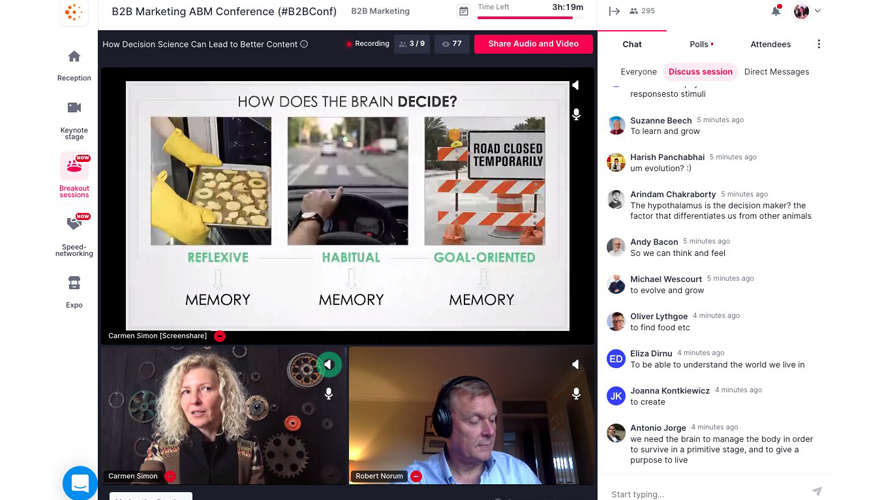
Inside B2B Marketing’s ABM Conference 2020
B2B Marketing hosted its fourth annual ABM Conference on 4–5 November. Held virtually, the event was loaded with presentations on campaigns, data and insights, and technology. Kavita Singh shares the highlights from each streamKeynotes Demandbase’s Paul Gibson gave a compelling keynote about how ABM can help ensure sales and marketing alignment. He also discussed why personalisation wins, why intent is the new lead, and why measuring everything is so vital today.He said: “ABM is proven to perform traditional methods across all of the key areas from the alignment between sales and marketing to increasing the lifetime value overall for your customers.”On Day 2, Chris Wickson held a compelling session on activating omnichannel ABM for better outcomes. He outlined the five steps for precision demand generation: using marketable connected data; connecting channels; using data intelligence; using martech integrations; and utilising insights. He also listed the common pitfalls that marketers need to look out for.These included:Using unmarketable or invalid buyer and account data.Too much technology.Not piloting or testing.Focusing on accounts, not people.Creating silos in your team and organisation.
11 November 2020 · ABM & Demand Generation

Adobe to acquire Workfront
Adobe has announced it has agreed to acquire work management platform Workfront, for $1.5 billion, subject to customary purchase price adjustments.The transaction is expected to close during the first quarter of Adobe’s 2021 fiscal year. Until the transaction closes, Adobe and Workfront will continue to run independently. Upon close, Workfront CEO Alex Shootman will continue to lead the Workfront team, reporting to Anil Chakravarthy, executive vice president and general manager, Digital Experience Business and Worldwide Field Operations.The combination of Adobe and Workfront will bring efficiency, collaboration and productivity for marketing teams. Workfront is equipped with APIs which can enable a connection to Adobe Creative Cloud and Adobe Experience Cloud, and can further Adobe’s leadership in customer experience management.Adobe and Workfront are long standing partners and a growing base of over 1000 shared customers, including Deloitte, Prudential Financial and T-Mobile. Workfront helps marketers efficiently manage content, plan and track marketing campaigns, and execute workflows across teams. Alex Shootman, Workfront CEO, said:“Adobe and Workfront share a common affinity to help the modern marketer thrive in an ever-evolving, increasingly demanding setting. We’re excited to join Adobe and believe this will be a tremendous opportunity for our customers and partners.”
11 November 2020 · Content, Creative & Campaigns

What does getting close to your customers really mean? You may be surprised.
B2B Marketing’s recent, excellent survey on the evolving role of the CMO, Evolution to revolution: How Covid-19 and behavioural trends will shape the role of the CMO, causing a seismic shift towards marketing-led organisations by 2030, confirms the primacy, the essentialness, of the CMO being (among a growing list of other things) customer-centric.That CMOs and marketers generally need to “connect with customers on their own terms, in an authentic and empathetic way” is not news. We know this for years and it remains a curiosity that the CMO’s “customer-centricity' is not more of a robust reality. But what exactly does it mean to be “customer-centric”? How can the CMO “own” the customer relationship? What does being 'close to your customers” actually look like, feel like, or result in?We believe a lack of fully understanding what “getting close(r) to your customers” really means, and requires, is the primary barrier to marketers’ still not achieving or delivering “full-throttle customer-centricity'.Customer-centricity: definedCustomer-centricity does not only mean that you know the products your customers buy, or the price points they prefer, or your sales force’s customer list (including birthdays); it does not only mean you know what they like and don’t like about your offering. These are price-of-entry facts, important, but table-stakes at best. What 'customer-centricity' does mean is what has more tellingly been called “customer-intimacy”: what drives customers to you, what is the source of their loyalty, why they prefer you and refer you. Customer intimacy means you know not only what motivates your customers and what it is about you that draws them to you. It means you know what they want before they know it. And believe it or not, this means you first understand how your offering, your brand, helps to make them better professionals: how you facilitate that they do a better job and gain greater pride and rewards, extrinsic and intrinsic, for their daily work. Because knowing this opens the door to understanding their motivations, and what would even bring them to you on their own, so long as you market to these insights and go far to support and anticipate them. This puts the holy grail of marketing at your command.This is what translates into business growth and results.
10 November 2020 · Customer Experience

How do high-growth businesses do marketing differently?
This year, Covid-19 has challenged B2B marketers in many ways: from collaborating with other teams to create innovative new customer journeys, to finding engaging alternatives to in-person events, many have been forced to pivot their approach to marketing, and fast. And while it hasn’t always been easy - it’s possible that the challenges of Covid-19 have actually created a braver, more resilient breed of B2B marketers; one that’s perfectly primed to lead their organisations towards future growth.In the past, high-growth businesses - those that grow 3x faster than their peers - have succeeded because they’ve done marketing differently. And for the past decade, the Hinge Research Institute’s annual high-growth report has highlighted key areas in which fast-growing businesses take a better approach to marketing than their competitors. But this year could be the year that B2B marketers from all sectors step up to help businesses close those gaps - because many of the ways in which businesses have been forced to adapt to Covid-19 have actually caused them to follow the best-practice examples set by high-growth businesses.Let’s take a look at some of those practices and at how B2B organisations can use them to secure an advantage in their marketplace:Prioritising their online presenceBusinesses that are aiming for fast growth need to focus on their digital marketing strategy, as the data shows that organisations that generated more than 66% of their leads from online sources grew more than twice as fast as firms that generated less than 33%. These businesses were 3x more likely to use digital ads, twice as likely to use video and podcasts, and 50% more likely to create downloadable content and carry out keyword research & SEO optimisation compared to their competitors, who were more likely to focus on live events and face-to-face marketing activities.While B2B may have previously lagged behind B2C when it comes to adoption of digital methods, the gradual shift from traditional to digital marketing within B2B has accelerated rapidly this year, with marketers getting creative in order to engage their customers and prospects remotely. At The Marketing Pod, we’ve had success with new digital approaches such as a week-long virtual event, and recent research from McKinsey found the amount of revenue generated from video-related interactions has jumped by 69% since April 2020. And with 70% of B2B decision-makers now saying that they’re open to making new, fully self-serve or remote purchases, while traditional marketing methods and live events will always be a key element of any B2B marketing strategy, it seems that digital is the way forward for businesses aiming for future growth.
10 November 2020 · Content, Creative & Campaigns

How to drive customer engagement in a post-pandemic world
Regardless of industry, product or service, one of the drivers to achieving business success is having a strong customer engagement strategy with which to acquire and retain customers.Due to the ongoing fallout from the pandemic, 2020 has been one of the most challenging years for businesses affected by consumer behaviour and buying habits.The UK is now officially in recession and consumer confidence is historically low. In order to improve and grow, businesses need to focus on what they can do to rebuild and repair customer relationships in these final months of the year ahead and beyond. Part of this involves focusing on relationship building with customers, in an effort to win back spend and loyalty.The challenge for support teamsThe past few months have been a challenge for customer support teams, as they seek to provide the level of attention that customers require, whilst also working effectively from the safety of their own homes. On top of this, the pandemic has caused a multitude of new issues that customers are facing and require support with, as well as of course feeling stressed and anxious about everything that is going on. Combine all of this, and maintaining a positive customer experience starts to seem like an impossible task.This is where improving customer engagement has a powerful role to play: two-thirds of companies compete on the quality of their customer experience and 96% of consumers agree that customer service is key to their purchase decisions. Ramping up customer engagement, therefore, has the potential to pay dividends down the line.
10 November 2020 · ABM & Demand Generation

‘In one word, what’s the key to being a great ABMer?’
And so the ABM Conference is over for another year. But what a conference it was! With streams on sales enablement, technology, data and insight, and content and campaign execution, it's fair to say that there's a lot of things B2B marketers can now actively look to improve on. But, to really break it down into its simplest terms, we recently asked our speakers this question: 'in one word, what's the key to being a great ABMer?'.
5 November 2020 · ABM & Demand Generation

When science fails, try storytelling
In Stockholm, there are some mornings when you just want to close your eyes to stop the gloom. But you fear the ice. Give it half a chance and it’ll lock your eyelids. You’ll be as blind as the rest of them.
5 November 2020 · Content, Creative & Campaigns

Defining ABM’s new era
On 16 March 2020, a whole era of B2B marketing ended.It was the day the UK announced a nationwide lockdown, and one that had begun with my team finalising one of our most comprehensive ABM programmes yet. It was for Veeam, the market leader in Cloud Data Management, and would have seen us roll out a multi-touchpoint operation that included thought-leading direct mailers, face-to-face sales meetings and an event.
4 November 2020 · ABM & Demand Generation

The Marketer's Guide to Customer Expansion
Check out Corporate Visions new e-book and get science-backed message frameworks for renewing your customers.
4 November 2020 · Content, Creative & Campaigns

Isio appoints Erin Hepher as head of marketing
Pensions advisory firm, Isio, has appointed Erin Hepher as its first head of marketing.She will be responsible for Isio’s client relationships marketing strategy and delivery. This includes firmwide corporate campaigns, and also content campaigns for targeted audiences. She will oversee a team of five based all around the UK. The firm first launched back in March 2020 and Erin became a permanent part of the Isio team in October.Previously, Erin founded marketing agency Aura Events, which helped clients to build stronger relationships with their most valuable client audiences. She was also featured in Management Today's 'Top 35 Under 35', a high-profile list of successful young women in UK business.Andrew Coles, CEO of Isio, said: “Achieving our vision and goals as a company requires the best talent across all areas of our activity, and Erin has already made a huge contribution to Isio’s trajectory as an independent company in the last six months. Her experience is invaluable to us and we’re delighted to have her on board permanently.'
3 November 2020 · Content, Creative & Campaigns

An interview with CMO of Skillsoft, Michelle Boockoff-Bajdek
This year, more than ever, diversity has been brought to the forefront in many forms, such as race, disability and gender. Michelle Boockoff-Bajdek, CMO of Skillsoft, spoke with Kavita Singh about some past experiences as a female leader.Can you tell me some of the challenges of being a female in a generally male-dominated field like tech? I’ll answer this question with a story: one of the biggest moments of my career thus far has to be working on the Women Leaders in AI programme at IBM. AI is an actual reflection of who we are as people. These systems are trained by human beings, but the field is largely dominated by men. As the technology becomes more pervasive, there is greater opportunity for bias that could impact anything from HR and recruiting, to customer service. To me, it was very important to voice the value of making sure this technology is developed with a diversity of thoughts and perspectives. This is a challenge that I, because of my gender, was acutely aware of and, as a result, passionate about solving. More than anything, it highlights the need for diversity in leadership – we need equal representation.How can women break that stereotype and attain these senior leadership roles?In my experience, there are keystone skills that unlock access to myriad others. For example, there is tremendous value in adopting a growth mindset. Seek continuous development, look for new opportunities, and open up to new ways of thinking. From there, the possibilities are endless. For marketers specifically, I would say some of the best skills to foster are curiosity, listening and awareness. Ask questions; don’t make assumptions. Really listen to customers; be aware of what they want and what they need. All of this is critical to ensure marketing is done side-by-side with them, not pushed towards them. Especially in times like these, where so much is uncertain and changing every day, it’s important not to create problems and present your brand as the solution. Instead, take the time to uncover their true needs and understand how you can help.
3 November 2020 · People, Teams and Skills


