The number one go-to-resource for B2B marketers across the globe


Case studies, webinars, reports, podcasts and videos from B2B Marketing, in one place.
Best practice briefing
A guide to overcoming the biggest challenges to becoming a commercial marketer.
A guide to overcoming the biggest challenges to becoming a commercial marketer.15,425 results · page 99 of 643

We’ve recently jumped on the webinar bandwagon. Why? Well, with event spaces well and truly locked up for the foreseeable future, we had plenty of content ready to be rolled out, including a couple of keynote presentations for expos that had since been postponed. So why wait? We decided to jump in headfirst.We’d never done a webinar before so we were a little dubious and actually downright scared. And we were right to be as, according to Medium, only around a third of sign-ups will actually attend your webinar. With this statistic in mind, not only was it important to reach as many people as possible, but also we were keen to beat that statistic and encourage more bums on virtual seats. As with any new marketing venture, we had plenty of learnings after the event, so we’ve split them into two parts. Part 1 of this blog focuses on the planning stages and promotion of the webinar, while Part 2 covers data collection and the all-important follow up.
25 August 2020 · Content, Creative & Campaigns
Kavita Singh spoke with Kathy Seegebrecht, CMO at UL, about her ‘Marketer of the year’ win at our Elevation 2020 awards.Q: What was your reaction to winning the award?Kathy: We’re so appreciative about it because B2B marketing is so different from B2C, and B2B has made strides over the past few years, especially at UL. We have really improved our capabilities and talent over the last five years and I just felt like “Wow, this is a wonderful recognition.” There’s so much more to do and we have to continue to evolve along with the market as a trend. I was extremely proud and excited.Q: What did UL look like when you first joined?Kathy: I started UL five years ago as the president of corporate marketing. They didn’t have a CMO, and we had about 12 people in corporate marketing. We were working with an agency in New York at the time who was not doing us favours and taking a lot of our money. They managed our website and it was so poorly done. Businesses didn’t enjoy working with this agency and they ended up building their own websites, so it completely proliferated our digital landscape and the same for social media. Our service offerings were, I’m not exaggerating, 248 websites and 80 social channels, and you just can't have impact with that and we didn’t have inhouse capabilities and did not have a demand generation function. We did not have a marketing automation platform or CRM either.
24 August 2020 · Content, Creative & Campaigns

David McGuire of B2B tech writers Radix Communications says it’s time B2B content aimed higher.Here’s a fun game. Open up your brand’s tone of voice or writing style guidelines, and I’ll guess what they say.“Conversational”, possibly. Perhaps “confident”. Likely “concise”, and almost certainly “clear”. And here’s a strange one: “human”.I don’t know what’s weirder. The fact that almost every B2B brand writing guide stipulates humanity, or that nobody in the industry seems to notice what a bizarre indictment that is.It’s weird that “human” needs sayingBecause what exactly is the alternative? I find it hard to believe that any company makes the conscious decision to sound like a robot, an alien, or – worst of all – a management consultant.Plenty of B2B brands do sound that way, of course. But not usually on purpose.
24 August 2020 · Content, Creative & Campaigns

Kate Cox talks about how lead generation can be achieved more efficiently by tracking the source of leads and focusing on the channels that are delivering the most, rather than by simply throwing money at the problem.Lead generation has always been a key focus for us at Moneypenny as we handle inbound marketing activity and customer enquiries for business of all shapes and sizes – from sole traders right up to multinational corporations. We ensure all phone calls and live chats are captured for our clients 24/7, either acting as a fully outsourced support, or as overflow to a client’s in-house team and if it’s a new business enquiry we can integrate these into their customers own CRM systems as a key route to growth.In terms of our own marketing, we operate across most digital channels as well as non digital ones such as DM, events and advertising in radio and newspapers, with multiple campaigns driving leads to our website, who then typically engage with the sales team via phone, live chat or web form, converting them offline.1. Knowledge is power – ensure visibility in your sales leads through to conversionWe had a reporting challenge for our marketing team, who lost visibility once a lead was handed to the sales team. We knew we were missing data on a large number of leads via paid search, particularly for those that came in via the phone. While we could cross reference leads in CRM, there was no way of accurately tracking the leads from phone calls or live chat back to a traffic source. This black hole in our reporting made it impossible to discern what separates a great lead from the crowd.We came across Ruler Analytics whose software made it possible for us to track not only calls, but leads from live chat and web forms too. It meant we can accurately track all visitors to our website and match lead data back to the original source. This enriched data is then pushed to Google Analytics and AdWords where our team can see leads, qualified leads and clients won, attributed to specific campaigns and keywords, which has removed time consuming tasks from our digital team’s to-do list.
24 August 2020 · Data and Insights

Channel marketing can a technical and complex discipline, and that can be off-putting for brands and marketers alike when there are more simple and sexy routes to market. But as we found out in our latest B2B Marketing Leaders virtual roundtable, in the wake of Covid19, channel marketing might be seeing something of a renaissance
21 August 2020 · Content, Creative & Campaigns

Last week I was delighted to be invited to join B2B Marketing’s Leaders Roundtable event as a guest speaker. The topic of conversation was undeniably a hugely relevant one – protection strategies for marketing budgets. And it was such a useful discussion, I thought it worth passing on some of the key insights… It’s given me lots of food for thought!A mixed budgetary bagSome marketing leaders have seen straight cuts of up to 50%, almost halting the majority of their half-two spend. Others have seen more modest reductions of around 10%, but have struggled to execute their plans with some, or all, of their staff being furloughed. And then there are others for whom the situation has been entirely different. They have found themselves offered more budget because their business has seen an increase in demand during lockdown. And the problem they have faced has been how to increase output when they have no additional people on the ground to do the work. It’s been quite a heady mix.However, despite all this disparity, one particular theme has come to the fore very strongly for all. The challenge of managing stakeholders during these tumultuous times is now stretching time management to its limit.
21 August 2020 · People, Teams and Skills

Market research and customer experience SaaS vendor Confirmit has appointed Tobi Andersson in a new role as chief product officer. The announcement follows the recent acquisition of Confirmit by Verdance, its merger with Dapresy, and the appointment of Kyle Ferguson as CEO. Andersson has over 20 years of experience in the global market research industry, most recently as the former co-founder and CEO of Dapresy.Andersson will now be responsible for the integration of the Confirmit and Dapresy’s platforms, working with customers, partners and product development teams globally to create a single platform.
20 August 2020 · Content, Creative & Campaigns

COVID-19 has accelerated the evolution of the B2B sales process, and in turn redefined multiple job functions across the entire sales and marketing ecosystem.With buyers moving away from the traditional in-person engagements with their sales reps to buying online through self-serve digital channels, business leaders must ask themselves: how do I equip my sales teams with the tools and insight to deliver value as they engage customers? Do I have the ability to easily engage customers and prospects digitally how and when they want? And through what channels? Do I have the ability to offer channel fluidity to customers in a manner that creates a seamless compelling experience that meets their expectations?It is clear that digital-savvy B2B buyers are not turning back to offline engagements. They are blazing ahead and driving the engagement with sellers to yield the offers they want and need. Sellers need to adapt to this buyer empowerment. Truly innovative sellers will have already made investments they can further expand to keep pace with how buyers want to buy.
18 August 2020 · Content, Creative & Campaigns

As copywriters, many of us are used to adapting our copy for different channels and formats - but when it comes to digital content, the list of copy considerations can seem overwhelming. From SEO to meta-tags, it can feel as though writing for digital is more of a science than an art - but by keeping these top tips in mind, you should be able to create copy that’s a beautiful blend of the two.It’s likely that your audience is spending more time online right now than ever before, with internet hits surging by 50%-70% since the coronavirus pandemic hit, as people strive to stay connected and stay safe. This means there’s a great opportunity for your business to connect with its customers through digital marketing campaigns - but as many of your competitors rush to seize this opportunity too, you’ll only reach your audience if your copy is optimised for a digital audience.Just how do you do that? Well, when you’re writing for digital, here are three things you need to know:1. Your audience is skim-readingA recent review of the differences between print and digital reading experiences found that when reading online, people tend to browse and scan, look for keywords (more on that later) and read in a less linear, more selective way. Multiple studies have found that reading from a screen makes us far more likely to skim the words we’re reading, and even when we’re skimming, we’re not reading linearly - instead our gaze tends to jump around the page, and we’re often distracted by elements like pull-out quotes or images.This means that copywriters need to write ‘skimmable’ copy, to ensure that the key messages and calls to action are picked up by online readers that are just scanning the page rather than reading every single word. There are a range of ways you can do this, but perhaps the most important is to keep your copy concise. Every sentence you write online should be valuable and add something to what you’re saying - there’s no room for waffle, as it’s likely that your key messages will simply get lost with the ‘fluff’.Breaking up your copy into smaller paragraphs and using subheaders to make the subject of each section of your copy clear can also help you to ensure your messages get across online, as this should enable readers to simply skip to the section they’re most interested in and get what they want out of your content.
18 August 2020 · Content, Creative & Campaigns

Research reveals that marketers have struggled to empathise with social change and global issues affecting their customers.Some 81% of brand representatives surveyed in July said they adapted their marketing strategy due to Covid-19 but 60% found it difficult to display appropriate empathy when doing so. The top three empathy focuses identified in the research for brands right now are: Covid-19, Black Lives Matter and mental health.The two most common barriers stopping brands from responding faster and more effectively to change are; the inability to measure and analyse sentiment; and a lack of knowledge around how to use data to predict the success of future campaigns.To help solve these issues and others, 97% of brands want to adopt technologies such as AI, to help them use data more effectively for predictive analysis and automated decision making.The research among 250 senior marketing decision makers in the UK, was conducted by Sapio on behalf of marketing AI company datasine.
18 August 2020 · Content, Creative & Campaigns

This is the age of the customer. Customers have more power than ever before and are now in control of their relationship with the business. With just a 5% increase in customer retention potentially increasing a business' profitability by 75%, it’s clear why improving customer experience is one of the key areas of focus for marketing departments.Customer experience has lately been brought into the epicenter of marketing operations, as the coronavirus pandemic affects critical KPIs in the business. Many organisations are redirecting their strategy to focus more on customer experience, from both a proactive standpoint and a reactive one. Two key ingredients in this process have been:data-driven marketing that enhances customer experiencedigital channels that are being used to deliver customer value through personalised messagesFor most industry sectors, email marketing is key to customer experience and loyalty. Doing it effectively can have a direct, positive impact not only on sales, but also customer engagement and loyalty. But how can an organisation improve its emailing practice during challenging times?
17 August 2020 · Data and Insights

As we ease into a new stage of Covid-19, it’s time to consider what will happen when businesses start opening up. Kavita Singh reports.Working from home will become the new normalFor the past few months, businesses have transitioned from the offices to the comfort of everyone’s homes. While for some, it was an easy transition, others struggled.As we begin to gradually ease out of the pandemic, it is now clear that businesses can be run from home. This means people can be more flexible with commuting and travelling to the office (depending on where you are). Perhaps it makes sense to loosen WFH restrictions for your company. Others might want to stay at home for the time-being for safety reasons, so make sure you’re respecting everyone’s needs, as well as those eager to head back to the office.Tom Castley, VP of sales at Outreach UK, said: “It should come as no surprise that more than half of office workers will continue to work from home for the rest of the summer. The lockdown has shown that while offices are nice to have, they are not fundamental for the running of many companies. Business leaders should remember post-Covid-19 that talent is accessible anywhere, and that includes remote workers. Not all talent is based behind the big city office walls.”
17 August 2020 · Content, Creative & Campaigns

We recently caught up with Rossa Shanks, CMO at Dow Jones, to discuss his current role and marketing challenge, his new book dedicated to ABM, and his advice for anyone undertaking ABM programmes in this new post-Covid world.Tell us a bit about you, and your background. How do you think this prepares you for your current role?My career so far has been eclectic but thematically consistent because I love creating stuff. I started my career at creative ad agencies, AMV BBDO and Grey London, working across many different brands, from Mercedes Benz and BT to The Economist and PepsiCo. It was a lot of fun creating TV ads and integrated ad campaigns.At Grey London, we pitched and won the News UK account. Six months later, the CMO of News UK poached me and I switched gears to B2C client-side marketing. Advertising is such a small slice of the marketing pie, so it was a great opportunity to take on a new learning curve. However, at the time, I had an entrepreneurial itch. So, it wasn’t long before I left to start my own business with a friend from the advertising industry. It was called Great Little Place — a user-generated little black book of the most charming places to go. I was CEO but, in reality, I spent a lot of my time as the de facto CMO because we were a small team.I believe start-up marketing is a discipline in and of itself. Building a company from the ground up requires imagination, grit and tenacity. So, I educated myself and read about viral loops and growth hacking and turned my hand to that. As a result, we grew our community to over 1.5 million fans on social media and managed to attract 110,000 founding members’ email addresses before debuting on the app store and being featured as Apple’s No. 1 app of the week.Working in the start-up world is a great adventure but, in the end, my corporate roots came calling again. The former CMO of News UK, who had previously hired me, had moved on to become president of Dow Jones in New York. So, when the call came to become CMO of Dow Jones across the pond four years ago, I couldn’t say no. It’s at that point that I had to learn B2B marketing from scratch whilst building out a whole new team.
17 August 2020 · ABM & Demand Generation

Cloud-based software Mavenlink has appointed Robert Pickell as CMO to accelerate a global marketing strategy.In this role, Robert who is an experienced SaaS growth expert will help Mavenlink’s market position as the leading provider of software, while working to further accelerate innovation and growth. Robert will bolster Mavenlink's strong market position and sharpen the company's differentiated value proposition, and grow its customer base.He joins Mavenlink from Kareo, where he directed the company’s growth strategy and execution. He has also worked for HireRight, Quantum Corp., Stamps.com, and Verizon.
12 August 2020 · People, Teams and Skills

IntroductionLong in the public domain, the case of Kevlar’s Values Ladder provides enduring relevance for B2B companies, any size, any category. If you’re under pressure from competition and need to differentiate, read on. If you need to refresh the market’s knowledge of your strengths and benefits to ensure a secure return to market, read on. If you need to move on from selling technical specs to selling your brand in all markets, in good times or bad, this case is for you.Kevlar basicsCreated in 1965 by Stephanie Kwolek, Kevlar is an ingredient brand with over 50+ uses in both B2B and B2C contexts. A para-aramid fiber, Kevlar provides lightweight strength 5X stronger than steel, and so is often used to replace metal. It is best known for its applications in protective apparel like bullet-proof vests, helmets and gloves, but is also used in sports equipment from ski boots and bicycle tires to racing sails; it is used in the mining and aeronautics industries; and in highly technical uses, e.g., marine current and wind turbines, particle physics.
11 August 2020 · Content, Creative & Campaigns

Kavita Singh spoke with Kate Farrow, everywoman’s director of learning, about how marketers can take steps to achieving gender equality within their business.Get uncomfortableBroaching any sort of topic that involves gender inequalities can be scary for both men and women. However, it is important for the entire team to challenge their own unconscious bias, and this starts with the business’s leadership team.If you look around at the senior level positions, are the majority of them men? If so, the first step is admitting that this is an issue in the first place. It is especially important that the leaders in your business are the ones who bring these macroaggressions and microaggressions to the forefront, as this enables women to feel more comfortable when speaking up.Kate Farrow, everywoman’s director of training, said: “Be clear and share widely throughout the business what behaviours exclude women. Often we are on the lookout for the worst behaviours that can exclude women, such as harassment and bullying, when microaggressions are more often experienced and just as harmful.”
11 August 2020 · Content, Creative & Campaigns
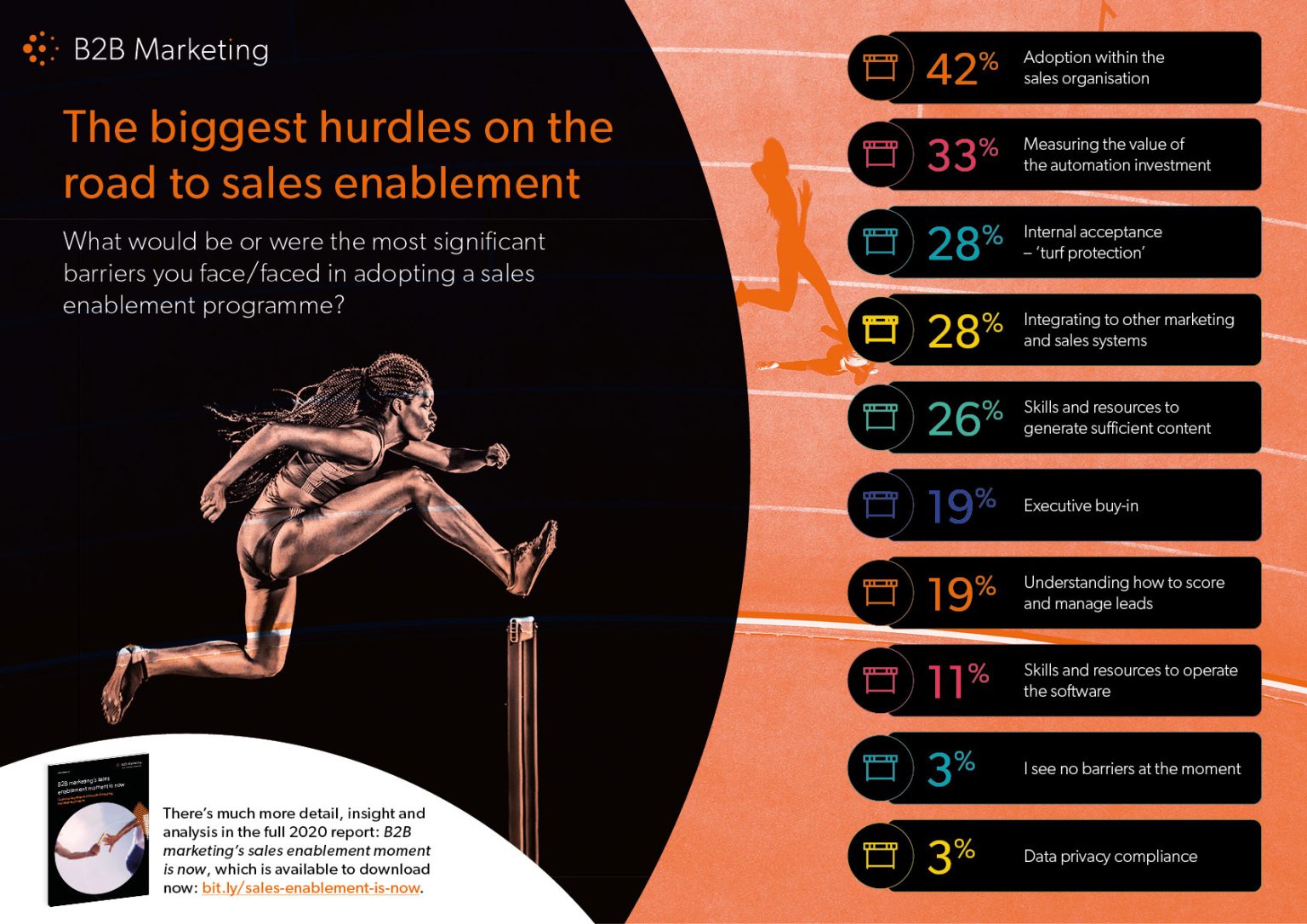
We asked B2B marketers what their biggest challenges are when adopting a sales enablement programme. Check out the full report here!
11 August 2020 · Content, Creative & Campaigns

Download this guide and find out how to increase customer retention and customer spend.
10 August 2020 · Marketing Operations and Technology (MarTech)

I’ve been reflecting on how the pandemic has affected the B2B marketing industry over these past few months. More specifically, what this means for us as we look ahead to the future, and the global recession ahead. As lockdown measures were introduced, campaigns were pulled, budgets were cut and members of our industry were furloughed - or in some cases, sadly, made redundant. This has even been the case for some of the industry heavyweights, despite their scale. But during these unprecedented times, the B2B marketing industry has shown incredible resilience. I have admired the collaboration, nimbleness and creativity I've witnessed from both individuals and companies who have adapted quickly to survive. For example, as physical events got cancelled we saw virtual ones quickly propelled into the mainstream. And as confinement measures were introduced, we saw brands that traditionally relied on out-of-home and print advertising rapidly shift their focus to digital, in order to reach their audiences. LinkedIn’s research shows that times are still really tough for a lot of the industry, with budget cuts and reallocations across the board. In fact, B2B marketers have been hit harder by the crisis than their B2C counterparts on that front, with almost three quarters experiencing budget cuts. However, both the research and my ongoing conversations show that B2B marketers are agile, resilient and optimistic for the future. In many ways, more so than their B2C colleagues, who are reliant on an increase in consumer confidence and spending.
10 August 2020 · Content, Creative & Campaigns

We are seeing several consistent trends that have emerged in recent years and are now being accelerated as a result of businesses and marketers adapting rapidly to a new business landscape and future of work as we know it. Specifically; Content: We are seeing a greater breadth of content delivered across multiple touchpoints. While quantity isn’t key – too much isn’t necessarily a good thing – the increase in engaging formats such as audio, podcasts and live digital experiences have never been more important. Traditionally perceived as dry, B2B content is now focussed on delivering innovative material and insight that drives a connection and engages audiences on a human level. B2B brands should be thinking about authenticity, providing help where they have credibility and being humble and human to achieve cut-through in a new era.Connection: Given this consistent cry for more human content, B2B comms are evolving, as brands recognise that business decisions are made by people, not organisations, which drives the need to interact with the individual and acknowledge their emotions and personal habits and preferences. This is reinforced by the changing and increasingly complex nature of the C-suite; as well as the traditional audience, we should be looking to engage younger, more diverse and digitally-focused decision-makers, the business leaders of today and tomorrow.Account-based marketing: The highly-focused nature of ABM benefits from increasing levels of data and indicators available, such as content consumption and digital signals. It is becoming increasingly intuitive and smart, with intent indicators used to demonstrate more intelligently where to take a more dedicated approach. An initial communication to top prospects, for example, can be honed down to target only those that engage, with online behaviour allowing one-to-one marketing and super-focused messaging (provided it’s helpful and human of course).
10 August 2020 · ABM & Demand Generation

This guide explores how sales enablement provides value across your organisation and includes valuable insights from author and internationally renowned sales enablement expert Tamara Schenk to help you strengthen your strategy
7 August 2020 · Content, Creative & Campaigns
Download this e-book and learn how marketing teams can play a pivotal role in building and sustaining trust between a company and its buyers with real-world examples
6 August 2020 · Channel Partnership

The integrated B2B tech marketing agency, Fox Agency has been appointed as a global social media and content partner by software provider Alcatel-Lucent Enterprise.The win follows a seven-way global competitive pitch process, with Fox Agency being selected over the incumbent agency.Fox Agency will support Alcatel-Lucent Enterprise in achieving its social media objectives through strategy development, content creation, video production, organic activity, paid promotion and social media monitoring, analysis and measurement. The Fox Agency team will work with Alcatel-Lucent Enterprise’s global marketing teams.Máire Collins, SVP Global Marketing at Alcatel-Lucent Enterprise, said: “In addition to technical expertise, knowledge of our market and a strong, strategic proposition, we were impressed with Fox Agency’s energy, enthusiasm and proactivity throughout the RFQ process – they bring an open, transparent and collaborative approach and we look forward to working with the team.”
6 August 2020 · Content, Creative & Campaigns

The survey continued with some questions about specific elements of SE: training, content and customer insights. B2B sales training is mostly static with room for improvementWhen asked who is responsible for seller training, 33% reported that there is a resource for that in the sales organisation. 15%, meanwhile, have the resource in marketing, and a significant 37% said ‘it depends on the project’, which would imply that there is actually nobody responsible – a product manager training the sales team before a launch should not count as sales enablement. The next question was about whether there is a software platform in place for seller education. An incredible 34% (the #1 response to this question) replied ‘don’t know’ – a worrying indication of how little attention some B2B marketers afford to the sales process of their own company. It’s no wonder that marketing/sales alignment is a challenge in these cases. Some 27% of the companies revealed that the corporate learning management system (LMS) is used for sales training, while 13% have a separate sales training system.
5 August 2020 · Content, Creative & Campaigns