The number one go-to-resource for B2B marketers across the globe


News, analysis and expert opinion from B2B Marketing — all in one place.
12,867 results · page 68 of 537

Cloud-based software Mavenlink has appointed Robert Pickell as CMO to accelerate a global marketing strategy.In this role, Robert who is an experienced SaaS growth expert will help Mavenlink’s market position as the leading provider of software, while working to further accelerate innovation and growth. Robert will bolster Mavenlink's strong market position and sharpen the company's differentiated value proposition, and grow its customer base.He joins Mavenlink from Kareo, where he directed the company’s growth strategy and execution. He has also worked for HireRight, Quantum Corp., Stamps.com, and Verizon.
12 August 2020 · People, Teams and Skills

IntroductionLong in the public domain, the case of Kevlar’s Values Ladder provides enduring relevance for B2B companies, any size, any category. If you’re under pressure from competition and need to differentiate, read on. If you need to refresh the market’s knowledge of your strengths and benefits to ensure a secure return to market, read on. If you need to move on from selling technical specs to selling your brand in all markets, in good times or bad, this case is for you.Kevlar basicsCreated in 1965 by Stephanie Kwolek, Kevlar is an ingredient brand with over 50+ uses in both B2B and B2C contexts. A para-aramid fiber, Kevlar provides lightweight strength 5X stronger than steel, and so is often used to replace metal. It is best known for its applications in protective apparel like bullet-proof vests, helmets and gloves, but is also used in sports equipment from ski boots and bicycle tires to racing sails; it is used in the mining and aeronautics industries; and in highly technical uses, e.g., marine current and wind turbines, particle physics.
11 August 2020 · Content, Creative & Campaigns

Kavita Singh spoke with Kate Farrow, everywoman’s director of learning, about how marketers can take steps to achieving gender equality within their business.Get uncomfortableBroaching any sort of topic that involves gender inequalities can be scary for both men and women. However, it is important for the entire team to challenge their own unconscious bias, and this starts with the business’s leadership team.If you look around at the senior level positions, are the majority of them men? If so, the first step is admitting that this is an issue in the first place. It is especially important that the leaders in your business are the ones who bring these macroaggressions and microaggressions to the forefront, as this enables women to feel more comfortable when speaking up.Kate Farrow, everywoman’s director of training, said: “Be clear and share widely throughout the business what behaviours exclude women. Often we are on the lookout for the worst behaviours that can exclude women, such as harassment and bullying, when microaggressions are more often experienced and just as harmful.”
11 August 2020 · Content, Creative & Campaigns
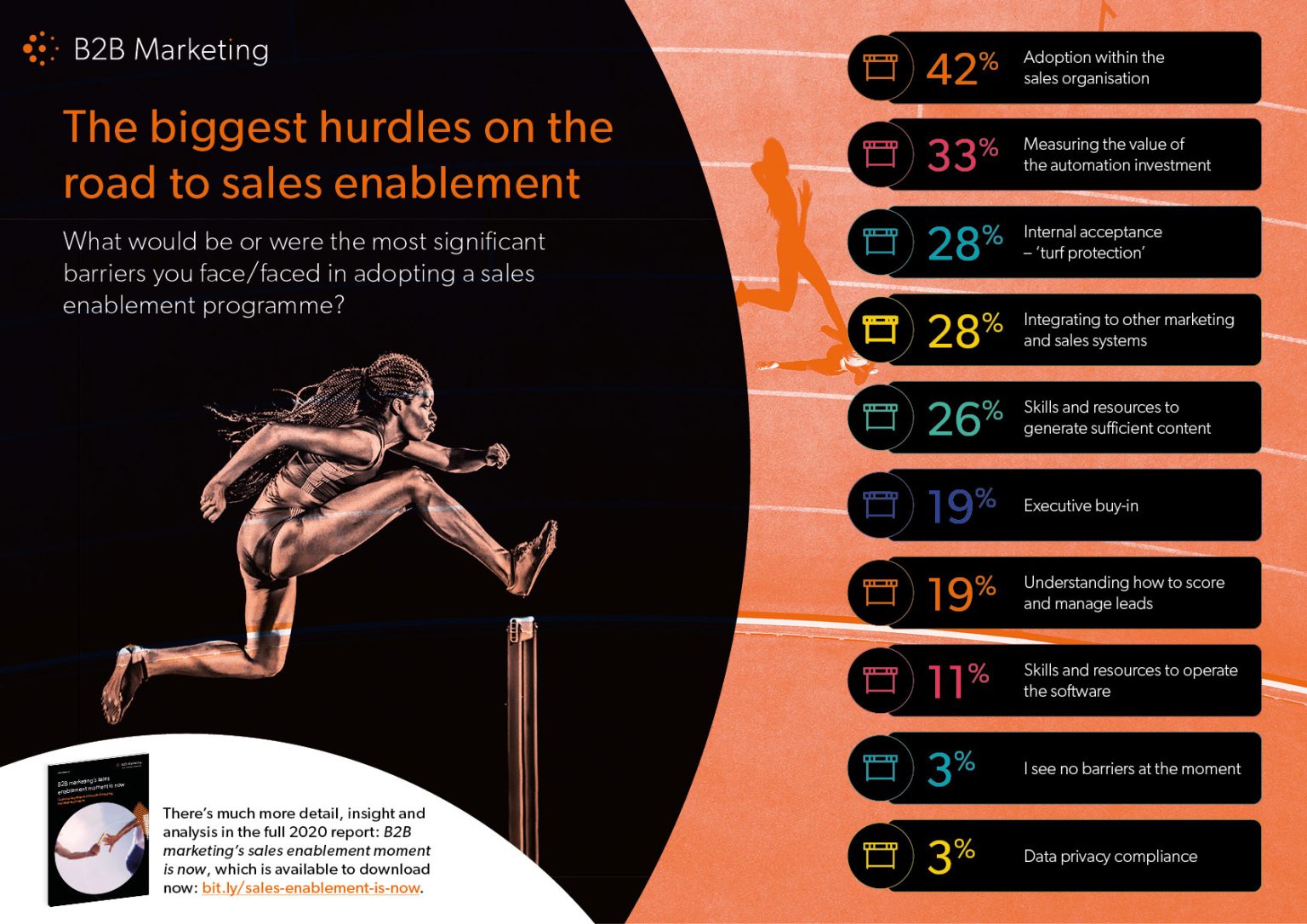
We asked B2B marketers what their biggest challenges are when adopting a sales enablement programme. Check out the full report here!
11 August 2020 · Content, Creative & Campaigns

I’ve been reflecting on how the pandemic has affected the B2B marketing industry over these past few months. More specifically, what this means for us as we look ahead to the future, and the global recession ahead. As lockdown measures were introduced, campaigns were pulled, budgets were cut and members of our industry were furloughed - or in some cases, sadly, made redundant. This has even been the case for some of the industry heavyweights, despite their scale. But during these unprecedented times, the B2B marketing industry has shown incredible resilience. I have admired the collaboration, nimbleness and creativity I've witnessed from both individuals and companies who have adapted quickly to survive. For example, as physical events got cancelled we saw virtual ones quickly propelled into the mainstream. And as confinement measures were introduced, we saw brands that traditionally relied on out-of-home and print advertising rapidly shift their focus to digital, in order to reach their audiences. LinkedIn’s research shows that times are still really tough for a lot of the industry, with budget cuts and reallocations across the board. In fact, B2B marketers have been hit harder by the crisis than their B2C counterparts on that front, with almost three quarters experiencing budget cuts. However, both the research and my ongoing conversations show that B2B marketers are agile, resilient and optimistic for the future. In many ways, more so than their B2C colleagues, who are reliant on an increase in consumer confidence and spending.
10 August 2020 · Content, Creative & Campaigns

We are seeing several consistent trends that have emerged in recent years and are now being accelerated as a result of businesses and marketers adapting rapidly to a new business landscape and future of work as we know it. Specifically; Content: We are seeing a greater breadth of content delivered across multiple touchpoints. While quantity isn’t key – too much isn’t necessarily a good thing – the increase in engaging formats such as audio, podcasts and live digital experiences have never been more important. Traditionally perceived as dry, B2B content is now focussed on delivering innovative material and insight that drives a connection and engages audiences on a human level. B2B brands should be thinking about authenticity, providing help where they have credibility and being humble and human to achieve cut-through in a new era.Connection: Given this consistent cry for more human content, B2B comms are evolving, as brands recognise that business decisions are made by people, not organisations, which drives the need to interact with the individual and acknowledge their emotions and personal habits and preferences. This is reinforced by the changing and increasingly complex nature of the C-suite; as well as the traditional audience, we should be looking to engage younger, more diverse and digitally-focused decision-makers, the business leaders of today and tomorrow.Account-based marketing: The highly-focused nature of ABM benefits from increasing levels of data and indicators available, such as content consumption and digital signals. It is becoming increasingly intuitive and smart, with intent indicators used to demonstrate more intelligently where to take a more dedicated approach. An initial communication to top prospects, for example, can be honed down to target only those that engage, with online behaviour allowing one-to-one marketing and super-focused messaging (provided it’s helpful and human of course).
10 August 2020 · ABM & Demand Generation

The integrated B2B tech marketing agency, Fox Agency has been appointed as a global social media and content partner by software provider Alcatel-Lucent Enterprise.The win follows a seven-way global competitive pitch process, with Fox Agency being selected over the incumbent agency.Fox Agency will support Alcatel-Lucent Enterprise in achieving its social media objectives through strategy development, content creation, video production, organic activity, paid promotion and social media monitoring, analysis and measurement. The Fox Agency team will work with Alcatel-Lucent Enterprise’s global marketing teams.Máire Collins, SVP Global Marketing at Alcatel-Lucent Enterprise, said: “In addition to technical expertise, knowledge of our market and a strong, strategic proposition, we were impressed with Fox Agency’s energy, enthusiasm and proactivity throughout the RFQ process – they bring an open, transparent and collaborative approach and we look forward to working with the team.”
6 August 2020 · Content, Creative & Campaigns

The survey continued with some questions about specific elements of SE: training, content and customer insights. B2B sales training is mostly static with room for improvementWhen asked who is responsible for seller training, 33% reported that there is a resource for that in the sales organisation. 15%, meanwhile, have the resource in marketing, and a significant 37% said ‘it depends on the project’, which would imply that there is actually nobody responsible – a product manager training the sales team before a launch should not count as sales enablement. The next question was about whether there is a software platform in place for seller education. An incredible 34% (the #1 response to this question) replied ‘don’t know’ – a worrying indication of how little attention some B2B marketers afford to the sales process of their own company. It’s no wonder that marketing/sales alignment is a challenge in these cases. Some 27% of the companies revealed that the corporate learning management system (LMS) is used for sales training, while 13% have a separate sales training system.
5 August 2020 · Content, Creative & Campaigns
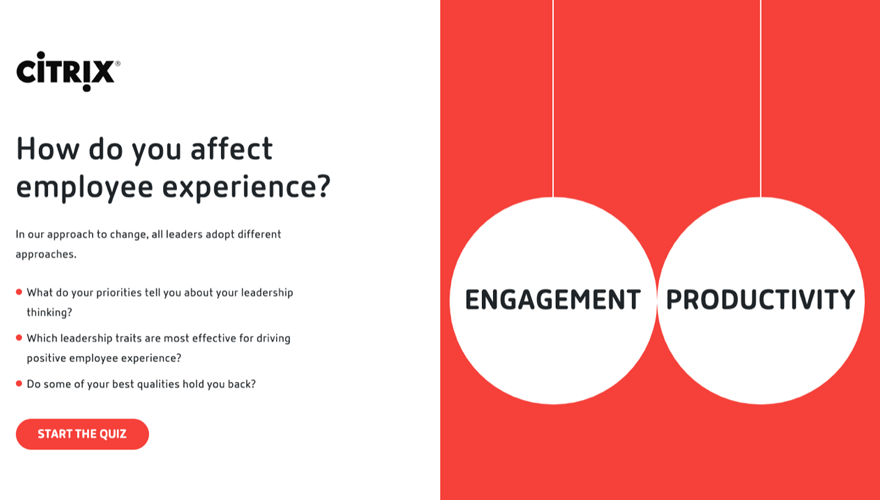
Digital agency LAB, part of the LAB Group of agencies, has partnered with Citrix to launch a digital campaign.LAB has worked with Citrix to develop a tool which asks people to find out their leadership type through a quiz. The campaign is designed to drive conversations with its audiences in key financial services, retail and professional services through hyper-personalisation. By using LAB’s expertise in psychology and human behaviour to profile leadership types, the campaign will run across EMEA.
5 August 2020 · Content, Creative & Campaigns

Social media has become one of the most popular, go-to digital marketing tools. But when it comes to business to business marketing, you’ll sometimes find that your target audience isn’t on social media. The businesses you are trying to target may have a company social media account, but the individuals that you want to market to and who will make the purchasing decision won’t have their own social media accounts. We take you through what to do if your target audience isn’t on social media.
4 August 2020 · Content, Creative & Campaigns

With lockdowns starting to ease, businesses are trying to navigate the new norm. Budgets are unlikely to bounce back quickly, forcing departments to look carefully at their spending. As B2B companies are reconsidering their sales and product strategies in a post-COVID world, there are opportunities for them to re-think how they deliver their marketing messages and realign their marketing budgets argues Jamie Kightley, Head of Client Services at IBA International. He warns B2B marketers that the days of five-figure monthly agency retainers are gone. They will have to follow a new paradigm to achieve PR and marketing success.During the coronavirus pandemic whole markets changed their focus – making ventilators rather than floor cleaners or F1 cars, gourmet restaurant chains making up food boxes for frontline workers, organisations going entirely digital or managing operations using remote assistance. The stories are legion.An opportunity to reassess communications strategiesThe ‘post-COVID-19’ business re-think has now begun. It isn’t just operations that will change due to the impact of the virus. With budget cuts affecting departments across organisations, communications budgets will also need a re-think. Everyone will want to get back to ‘business as usual’ as soon as possible, but budgets will not instantly return to previous levels, and without the same financial resources, many organisations will struggle to return to high-fee agencies.
4 August 2020 · Content, Creative & Campaigns

Prospecting and finding new leads, and actually converting those leads to sales is a lot easier said than done. For some, the thought of actively engaging with new prospects invokes images of door-to-door salesmen pounding the ground and giving the hard sell. But there is some good news. As you may already know, the best business marketing solutions are found online via social media, and they are often free or close to it. Furthermore, 80% of B2B leads sourced from social media come from LinkedIn. Needless to say, failing to utilize LinkedIn to help generate leads will most likely be a major missed opportunity. In this article, we will explore the power of Linkedin as a marketing tool for generating free B2B leads, and some tips on how to begin using LinkedIn as a first step in part of a larger digital marketing campaign.
4 August 2020 · Content, Creative & Campaigns

In the post-Covid world, making sure you prioritise which prospects and customers you focus on is crucial to your organisation’s success. At Ignite London, Chris Ashley-Manns and Charlie Nicholson outlined their ABM process to help you do this, and highlighted some key considerations that need to be taken into account. This article is just one of many ABM-focused pieces that will feature in our upcoming Summer 2020 issue of B2B Marketing magazine.
3 August 2020 · ABM & Demand Generation

Sarah Thomas is the chief strategy officer & advisor to the CEO at HFS Research, and the co-founder & managing director at Thomas Grey. She also happens to be a virologist! We recently caught up with Sarah to get her insight on Covid-19 and its impact on the world of marketing.
30 July 2020 · Content, Creative & Campaigns

We fielded a series of questions to assess the progress or maturity of SE programmes in B2B, and also collected input about the most important influences or drivers for the programme, as well as the most significant challenges. When asked about SE, 28% of the respondents claim that their company has an agreed and documented SE programme, and another 45% report that they are in the process of putting one together. The remaining 27% of respondents have no plans for an SE strategy, citing reasons such as ‘company too small’ and ‘sales force too small’. These are probably the SMEs that replied to the survey with revenues under £1 million (20% of the UK respondents), under $1 million (18% of North American respondents) or €1 million (10% of the EU respondents). The vast majority (69%) of companies expect to increase their team’s SE deployment in the next 12 months. Other, even more recent, research carried out by B2B Marketing indicates that the Covid-19 health and economic crisis is changing the buying process even more radically than assumed, and the changes will probably be permanent, so there is now an increased sense of urgency in SE. Most companies are developing a sales enablement programme.
29 July 2020 · Content, Creative & Campaigns

In the B2B marketing world, one of the most important stages of your campaign will be optimising your website for conversions. Assuming you have a solid traffic generation strategy in place, your site should be flooded with visitors—so how can you make sure that your visitors buy your products, fill out your contact forms, and download your content? The answer is conversion optimisation. With the right set of tactics, you can increase the percentage of website visitors who ultimately convert. Unfortunately, many B2B marketers find themselves plagued with a low conversion rate despite their optimisation attempts. What could account for this, and what steps can you take to correct this issue? The Most Common Problems in Conversion Optimisation When most B2B marketers experience issues when optimising for conversions, the root cause is one of these 10 problems: You’re targeting the wrong audience (or no audience at all). First, you may be targeting the wrong audience, or worse, having no target audience in mind. This problem applies both to your traffic generation strategy and to the framing of your onsite calls-to-action (CTAs). If your messaging isn’t relevant to a specific audience, it’s not going to be persuasive. Make sure you do the demographic research necessary to better understand your target market, and craft your messaging to be specific to them. Your content is low quality. It could also be that your content is too low quality. If you write about your products and services in an unskilled way, or if there are critical mistakes in your other onsite content, it could leave visitors with a bad impression—making them unwilling to convert. Your calls-to-action (CTAs) aren’t visible. People will only convert if they can find your CTAs. If your CTAs are hard to see due to their positioning, color, or other factors, your conversion rate is going to suffer. Your pitch is uncompelling. Most conversions include a pitch, especially if you’re selling products or services. What are the benefits of making this purchase, and who are these products and services “right” for? If you’re not able to make a compelling pitch, people won’t make the purchase. There’s no incentive to convert. If your conversion involves filling out a form rather than making a purchase, the incentives could be the issue. If you want people to hand over their personal information, you need to give them something in return—like a piece of premium content.
29 July 2020 · Content, Creative & Campaigns

B2B copywriter David McGuire thinks the case for storytelling is well understood; the trick is doing it well.Right from opening keynote, when Tas Tasgal told the audience “Numbers numb us, but stories stir us”, it felt like there was only one subject people at Ignite London wanted to talk about.Storytelling is big news in B2B. Especially now, when brands are desperate for marketing content to win the attention of distracted prospects and make a connection with people who feel unsettled. It’s always a key topic in my copywriting training sessions, and B2B Marketing even has a dedicated storytelling course for those who really want to get into the structure and substance.Across the three days of Ignite, speaker after speaker referenced the power of story in driving business outcomes – and responses from delegates in the event chat and networking rooms made it clear that marketers as a whole no longer need convincing.My guess is you probably already know that story is a powerful tool. Instead, perhaps you’d like some suggestions about when you might reach for it, and how you can use it well. (And strangely, a lot of them come back to the numbers…)Three B2B uses for story: Illustrate, differentiate, precipitateYour business does not have one story; it has thousands. And each one lends itself to a different job. To get you started, here are three moments when a touch of narrative flair can change a marketing outcome. Use 1: Show what your data meansData is great, of course. It can help you demonstrate points of difference, or spot patterns and react. It can help you prove that your story is true.But all data started in the real world: measurements from real-world objects, real people, and real things that happened. And to make the data meaningful, you need to translate it back into real-world implications – tell the story of what the numbers show.As Dr Christine Bailey of Valitor said in her Ignite talk: “We need to use data and insights to tell the story.” Data grounds the story in reality, but the story gives the data meaning.
28 July 2020 · Content, Creative & Campaigns

Kavita Singh spoke with CEO of Bader Rutter Jeff Young about the company’s 2019 and 2020 distinctions.This year, Bader Rutter has won multiple awards, including the #1 B2B marcomm agency in the US, the #1 Global B2B marcomm agency with global partner BBN, and the #1 AgriMarketing Agency in the US. Hear what its CEO had to say about how it was able to achieve these distinctions.Q: Can you tell me your reaction to winning these distinctions?With some agencies, it’s all about winning awards and for others, they don’t care about awards, they simply care about their client’s business success and I would say generally we lean in that direction. Awards are nice, but they’re fleeting. What persists over time is the client's business success.Q: What works well about your partnership with BBN?We’ve been partners for nearing 20 years now. We were constantly being asked about our global presence and at that point in early 2000s, we didn’t have a global presence. We were fortunate to hook up with BBN and learned that we shared a number of common practices. If you think about an approach for client services, we follow similar processes to that for planning, branding, and creative development. We meet multiple times a year, and we share clients when appropriate. It’s like a co-op of intellectual power and it’s been wonderful for us.
27 July 2020 · Content, Creative & Campaigns

Recent weeks have seen new policies emerge in the UK as lockdown measures begin to be eased. Increasing numbers of businesses are re-opening and, in England at least, we are no longer told to ‘stay home’ but rather to ‘stay alert’. Accompanying the headline slogans are various documents. There are now policies on everything from ‘Construction and Other Outdoor Working’ to ‘In-Home Working: Other People’s Homes’ and ‘In-Transit Working: Vehicles’.So is this helping? The answer may well depend on the size of your business.Our recent covid-19 business sentiment tracker found that larger businesses are becoming more confident, whilst smaller businesses seem increasingly confused. Asked to what extent they agree that “after the change in Government advice… my business has clarity about what will happen over the coming months”, net +34% of medium and large businesses (>250 employees) agree, compared to net -13% of small businesses (a 47 point difference).As a result, over two thirds (69%) of small businesses say that they have ‘not made any changes following the shift in Government advice’. This trend is further reflected by confidence in the Government’s strategy for dealing with covid-19, which amongst small businesses has dropped by 8 points to below half (47%), whilst amongst medium and large businesses it remains steady and 14 points higher (61%).
27 July 2020 · Content, Creative & Campaigns

Cognism CEO James Isilay explains how marketers can transform their email signatures into a marketing tool.With face-to-face events cancelled to help prevent the spread of COVID-19, one channel is seeing a dramatic surge in popularity.For B2B marketers, email is becoming the most effective channel as companies adapt to the new normal. At the start of lockdown, email volumes rose 29% in a single week, compared to the same period the previous year.That same week saw open rates rise 53%. But simply sending more emails isn’t enough. Indeed, email volumes rose but response rates started to decline. This means emails must engage and add value while reassuring potential customers that they’re more than just a sales metric.
27 July 2020 · Content, Creative & Campaigns

Work management platform Workfront has announced that head of global development Paige Erickson has been appointed to managing director of Workfront’s operations across Europe, the Middle East, and Africa. Paige will be leading all EMEA functions, including strategic planning, sales, marketing, and customer experience.She will also be driving global partner strategy at Workfront and serve on the company’s executive leadership team. Paige joined Workfront back in 2016 as senior VP for business development. Prior to joining Workfront, Paige was VP, partner strategy and operations at Sage Software, where she led the North American partner team.
27 July 2020 · Content, Creative & Campaigns

A new strategic services agency, The Planning Department, has launched.Steve McCarron, Rebecca Ashley and Helen Davies have all teamed up to launch a new agency. As clients and agencies adjust to the tough economy, they have come to depend on smaller teams which are able to scale up as required by bringing outside specialists in.
22 July 2020 · Content, Creative & Campaigns

Margaret Arakawa, CMO at Outreach, spoke with Kavita Singh about how marketing and sales can help each other during Covid-19.Q: How has Outreach been affected by Covid-19?MA: It’s interesting as a company, we have spent a lot of time making sure that people were safe and that our customers had what they needed. We started working from home early on. We communicated a lot to make sure if anyone had issues, we were here.Last year in North America, we were the fourth fastest growing company in America across any kind of industry. Telling a customer ‘Hey, would you like to grow super fast right now in a Covid-19 environment’ is extremely tone deaf. Companies are going away, and people are being laid off, so we guided folks on what are the things they really need. We actually helped a lot of companies tailor their messaging, but we wanted to help them. There are some companies that are exploding right now as well. For example, Zoom is expanding, and right now, they want to know how to expand faster than ever before. So really, we were looking to see where the customers were at with their businesses. Some were expanding, while others were struggling.
21 July 2020 · Content, Creative & Campaigns

There is now a clear drive by companies in most B2B sectors to optimise the customer experience, leading to digital content marketing processes such as customer intelligence and analytics, deeper persona research and personalisation, and interactive media. This improves the experience for both established customers and potential buyers.However, even with these digital buying experiences, B2B still relies greatly on human interactions, particularly when salespeople meet buyers to discuss a complex purchase or project, or just routine orders for replenishment supplies. In addition to this, digital buying experiences also affect how sellers exchange information with buyers and have, more importantly, changed the expectations of buyers. Just as in the consumer world, B2B buyers now prefer to research products themselves rather than ask a vendor sales rep for information.This new buying paradigm shifts the roles and focus of B2B marketing and sales. The balance of customer interaction has edged towards the former and the role of sellers has changed: they are part of the buyer journey dialogue instead of leading it. Instead of product features, they are often asked about how a product can be applied to a specific use case or other business-orientated questions. Or they are expected to explain or elaborate on some of the digital content that the buyer may have already researched.The savvier marketers have already extended their digital marketing processes to directly support sellers with this information, bringing at least these vital benefits:› Productivity. Both marketing and sales benefit. Sellers can leverage good digital content, provide value to their contacts, and be a channel for marketing messaging.› Brand/message management. The governance process is automated, although some customisation must be allowed to enable sellers to personalise content. But there is also much more that marketers can provide to sales. For example, customer intelligence on organisation, intent and research history; or content that can be finalised and tuned by the seller.
20 July 2020 · People, Teams and Skills