



Resources
Case studies, webinars, reports, podcasts and videos from B2B Marketing, in one place.
Featured
Best practice briefing
A guide to overcoming the biggest challenges to becoming a commercial marketer.
A guide to overcoming the biggest challenges to becoming a commercial marketer.15,425 results · page 78 of 643
Ignite London 2021 Session: Supercharged B2B
At Octopus Group, they’re looking at B2B to push revenue in tricky times. Watch their session to find out what’s supercharging B2B.
5 July 2021 · Content, Creative & Campaigns
Ignite London 2021 Session: The Business Of Brand: The Business Case And Why Your Brand Needs A Rethink
In this session, a panel of industry leaders discuss why businesses need to wake up and realise the power of brand.
5 July 2021 · Brand
Optimising the ecommerce experience in B2B marketing with Brian Beck
In this week’s episode, David Rowlands, editor for B2B Marketing, sat down with Brian Beck to discuss all things ecommerce.
30 June 2021 · Customer Experience

Creating more effective global campaigns with Sam Crocker
Kavita Singh spoke with Sam Crocker, managing partner at Bray Leino, to discuss what makes an effective global campaign in B2B marketing. To find out more, check out Sam’s session at Ignite London, where he’ll be sharing even more insights with Tony Riley, president of The Mx Group. 1) What is your session about? Our session focuses on effective global marketing and the belief that, as an industry, we can be better. Through our transatlantic partnership with The Mx Group and through working on numerous global accounts both as agency of record and as a regional execution partner, we will offer our perspective of common pitfalls of global campaigns and how to avoid them. We’ve packed a lot into our half hour chat, and we want attendees to come away with some great insight, but also some really valuable new strategies and ways of thinking. 2) What is the key to an effective campaign? Our view is that there are five common pitfalls as to why global campaigns often fall down, we will state these and how to avert them at the talk, but fundamentally they come down to two things: Ensuring that campaigns are based on a ‘big idea’, and that idea rooted in a universal ‘human truth’ which will transcend countries and cultures. Trying to deliver one unified message across the globe is reliant on tight alignment and clarity amongst an ecosystem of agencies and partners. 3) What are some common missteps that you've seen from global campaigns? We co-hosted a roundtable event with The Mx Group at B2B Ignite USA, and there was vehement agreement on some of the common missteps we think many readers will recognise: Assuming that because a campaign worked in the home market it will work everywhere else. Simply translating a message from one language to another. Adaptations are often defined by language versus country and culture, so for example assuming the US and UK are fundamentally the same just because they’re both English speaking. Failing to fully consider personalisation at scale and managing agency ecosystems. Getting agencies to communicate with one another is a challenge but an important step.
29 June 2021 · Content, Creative & Campaigns

How to be an ally post-Pride month
With June coming to an end, that also means that Pride month is coming to end. However, the allyship must continue. According to a research study by Accenture, approximately 59% of employees aren’t open about their sexual identity. As amazing as it is to see support worldwide, how can we become better allies in the B2B sector? Well, first thing’s first. If you haven’t, go update your LinkedIn profile with your pronouns. As a cisgender woman, I have no issue putting (She/Her), but if it helps others feel more comfortable putting their preferences, well, that’s what being inclusive is all about. But it goes beyond doing the bare minimum. If your company did change their logo during this month, ask yourself if you earned it or was it just a matter of asking your designers to change the logo? If you haven’t done anything in terms of policies, initiatives or inclusivity, then it will come off as performative. Before events like these, it’s so important to remember the intention – is it to create a safe space, or is it to come off ‘politically correct’ and boost sales? But there are things you can do post-Pride month to be an effective ally. Research (especially if you’re at a senior level) Being in the know is absolutely critical. The more informed you can be, the better. The transgender community still faces an obscene amount of hate crimes daily, and people that identify as gay, transgender and bisexual are twice as likely to experience mental health related issues. When you care, you’ll be more inclined to offer support, and, if you brush off these statistics, it comes off as if it’s ‘not your problem.’ And once you start learning more about LGBTQ+ issues, you’ll be exposed to charities, causes, initiatives and programmes that you’ll be able to offer or look into for your employees. One thing that was interesting to hear from our most recent B2B Marketing Ignite USA conference was when the CMO of Accenture, Joseph Taiano, spoke about affinity groups at his company. When he first joined Accenture, he joined one, which brought together marginalised groups around a cause. At the time, Joe said he didn’t have many gay friends, so he joined an LGBTQ+ employee resource group. If your company has the resources, it’s worth the investment, but if you don’t, there are several charities and organisations you can join and look into such as Workplace Pride, LinkedIn’s Out in Tech and Free Equal United Nations.
28 June 2021 · Content, Creative & Campaigns

Can you outsource your sales team?
In the world of B2B Sales, pre-sales as a process and appointment set-up as a function have acquired a key stake in the ultimate achievement of revenue numbers for any large corporation. This specialised function enables the actual sales folks to attend to opportunities post proper qualification screening and establish the critical buying signals, including the industry-standard Budget/ Authority / Need / Timeline – BANT criteria. Most organisations do this internally with a team of SDRs. However, some of the B2B demand generation companies have started offering such services as an outsourced function in the recent past, but the success is limited. Appointment Setting (AS) is a complex process, and it involves intricate and seamless development of a complete campaign plan in coordination between marketing and sales. Therefore, this cannot be a standalone sale driven initiative. When we look at the OS model of Appointment Setting, this becomes even more complex since the SDRs are not working just on a dedicated program but will be working on several programs simultaneously. In most scenarios, such programs are success-based, meaning the provider gets paid only when they close a qualified appointment. Too often, such initiatives lead to low levels of success and the quality of the appointed candidates will be bad if checkpoints aren't verified thoroughly. Such OS services need a higher category of folks than your generic telemarketing agents. It is a specialised role that would require a bit of tenured sales folks to be working on. The failure of many programs that are OS have their roots in this core issue – they consider appointment set-up as an extension of their lead generation functions. However, such programs need investment and effort from both the buyer and seller to deliver fully trained SDRs, who have been trained on the client’s products/services, the value prop, and the high-level pitch. The cost of failure is high with such initiatives since the prospect would be left with a bad experience that would take years of effort to correct or remedy. One of the key success parameters for AS programs is synchronising the messaging between the marketing/sales and the OS SDR functions. It helps to have consistent messaging across the board so that any touchpoints a prospect has with the company is communicating the same message. If you are an organisation looking to explore appointment set-up as an outsourced function, it helps to go through the defined process below for a better success rate. Like every function, we recommend organisations to have a defined and progressive framework that ensures that all aspects of People-Process-Technology are covered and signed off during an outsourced SDR function's design and implementation.
28 June 2021 · Content, Creative & Campaigns

7 copywriting tips I won’t be sharing at B2B Ignite 2021
David McGuire previews his B2B Ignite session – by revealing seven B2B copywriting tips that are not in his talk. Before we begin, let’s get one thing straight: writing engaging marketing content is never easy. And that goes double in B2B, where you have to juggle complex, technical subjects and appease stakeholders, while still somehow sounding human. Even for an experienced B2B copywriter, it’s a tall order. (People seem to think that writing is easier when you’re a full-time professional, but nothing could be further from the truth. Imagine agonising over every comma.) But a professional copywriter does have one big advantage – we have a whole locker of tips, tricks and cheats to help us get from a blank page to the final draft. In my session at this year’s B2B Ignite, I’ll be sharing seven of my favourite tried-and-tested copywriting tips. Simple, practical things you can take to work and use the very same day. I’m not going to reveal those tips here; that would hardly be fair to the delegates (if you want them, you’ll have to come to Ignite on Thursday). But don’t worry; I will share an entirely different seven copywriting tips that I considered including in my talk. They won’t make the writing process easy, but they might make it a little less hard. Tip 1: Set yourself a fake word limit. Reduce it for the second draft. One of the joys of digital marketing is that there’s rarely a hard word-count limit anymore. And that’s great, but it does mean that content can sometimes become a bit bloated – whether it’s a slightly rambling document structure, or simply unnecessary extra words, phrases and synonyms which start to magically appear throughout the text to inflate and expand the sentence, like this. Problem is, your reader’s busy (have you ever met a B2B decision maker who wasn’t?) and they want you to get to the point. Every needless word gets in their way and dilutes your message, so it’s important to know when you’re adding value, and when you’re waffling. By contrast, when your word count is limited, you immediately consider each word, to see which are pulling their weight. And if you have to go back and edit words out, what’s left behind is usually stronger. It’s a distillation process. So set an arbitrary word limit when you write. Then review your work, and reduce it by 10-20%. You’ll be surprised how much you don’t need. (Hint: you can almost always delete “that”.)
25 June 2021 · Content, Creative & Campaigns

Turning pitches into experiences
So, you’ve got a big pitch to win. You’ve outlined the keys USPs, everyone on the team knows their part, and you’ve managed to slim the PowerPoint deck from over 150 slides to something more manageable. But did you know that deals are more likely to be won if they’re part of a seamless brand experience? Here’s how we can help you turn pitches into experiences – telling stories that truly connect with your clients. The four fundamentals So how do we do it? When it comes to helping our clients to win, we believe in four things. Simplicity speaks to leadership You’ve got a lot to say, and not much time to say it. However, your audience won’t remember every single bullet point – they’re busy people with a business to run. In fact, they’ll typically only remember one thing once the presentation is over. To have maximum effect, we recommend that you make the experience of working with you the thing that they’ll never forget. Dare to have a big idea The role of a big idea in pitch experiences is just as important as it is in any other campaign: It underpins everything. Bidding for a global fast-food chain, for example, is about more than burger-shaped mailers. They might raise a smile, but the chances are they’ll have seen it all before. Remember, It’s the idea beneath the material that will make or break your response. Our dedicated teams hunker down and generate ideas for you thick and fast, that appeal to the audience and cut through. Your success is our success You may have heard of the term bid support. That’s technically what we do, but we offer so much more. We prefer for you to think of us as a partner. We’re in your corner; we feel the elation of your wins and share the losses. Our mission is to put a smile on your client’s faces. For example, we created a pitch presentation to one of the world’s largest retail companies, built entirely around experience, with absolutely no PowerPoint. Using a mixture of technology and physical space, we created a fully interactive environment that brings the offer to life, leading to a win and a wealth of positive feedback from our clients and their prospects.
25 June 2021 · ABM & Demand Generation

Integrate extends demand marketing capabilities with launch of Precision Events
Integrate has announced its launch of Precision Events, a new platform that aims to create a more connected, buyer-driven demand marketing strategy. Integrate’s new platform, Precision Events, platform allows marketers to connect their event interactions with buyers and accounts to their digital demand strategy to drive more revenue at scale. The new events platform also includes new integrations to virtual and webinar platforms so that customers can route their webinar lead data through the Demand Acceleration Platform. In addition, the service has security protocols in place, including single-sign capabilities with identity providers and SOC-2 compliance. Back in April of this year, Integrate, has announced its launch of its Demand Acceleration Platform to centralise and connect the B2B buying experience. Integrate’s DAP provides a scalable service for growth and enterprise organisations to drive omnichannel demand strategies, orchestrate intelligent buyer and account journeys, convert leads and accounts to revenue, and demonstrate marketing ROI. Chris Wickson, general manager, EMEA at Integrate, said: “The past 15 months have irrevocably changed B2B events, and it’s clear we can’t simply go back to the way we did things pre-pandemic. We’re now in a digital-first, buyer-driven era and as in-person experiences start to become a reality once again, Marketers will need to adopt a holistic event strategy that connects in-person and digital channels and aligns with a broader demand strategy. That’s why we’ve launched Precision Events – to support a more connected, buyer-driven Precision Demand Marketing strategy across the range of event formats and channels.”
24 June 2021 · ABM & Demand Generation

The death of third-party cookies
Next year, Google Chrome, Firefox and Safari will all abandon the use of third-party cookies. Propolis Hive Experts Tony Lamb and Robert Norum joined Julia Porter, data protection expert, for a B2B Marketing webinar about what this all means for marketer’s data in the future. Why are third party cookies disappearing in the first place? In 2019, the Information Commissioner's Office (ICO) confirmed that GDPR consent was now required for the placing of cookies and other technologies. This meant that, overnight, lots of websites became non-compliant. In that same year, the ICO launched an investigation into adtech and real-time bidding, but, with Covid-19 at the forefront, interest in cookies faded out. With the pandemic gradually beginning to end, interest in cookies has swivelled back around in 2021, specifically around the inevitable death of them. One occurrence that led to the death of cookies was back in August 2020, when there was a privacy collective clash action against Salesforce and Oracle. By September, Oracle Data clouds stopped offering third-party data targeting services across Europe. And then finally, the news with Google was the nail in the coffin. Google is centred around 65% of all browsers globally, so when the company announced they’re no longer supporting third-party cookies by 2022, it was a real game-changer Julia says: “With the ICO, they’re not definitely going to take anything away from you, but they might make your life a bit difficult. That’s the biggest difference between the ICO’s involvement and the news about Google. Even though this has been coming for years, it’s like the rubber hits the road. It’s like: ‘Oh, gosh, I'm actually going to have to do something different now’.” What happens if you don’t do anything? So, the question is: what happens if marketers ignore this, and how will it affect their analytics? Julia explains that marketers are going to lose a lot of data if they choose to ignore the news. She says: “Well, I think my understanding is that you'll still be able to use Google Analytics on your own sites, but what they're effectively doing is collecting all the data now and going to create these cohorts, which are your audience profiles. Then you can target your advertising against these cohorts so that you, the marketer, no longer get to see who those individuals are. You target cohorts now with new points of view, depending on how you are driving your marketing.”
23 June 2021 · Data and Insights

The 4 pillars of being a thought leader
We see it being thrown around left, right and centre – the concept of becoming a ‘thought leader’. But what is a thought leader and how do we become one? Atlassian’s Ashley Faus breaks down the four pillars to becoming an influential and impactful thought leader. Kavita Singh reports. Before diving in, it’s critical to note that these four pillars work together in tandem. You can’t just be outstanding on one pillar and neglect the others. Chances are you’re lacking in at least one of these. Credibility The first pillar revolves around credibility. This is when you need to ask yourself: Do you trust what you’re saying? Do other people believe what you’re saying? Do they think you know what you’re talking about? From a tactical point of view, there are several ways to establish authority and boost your credibility. This means you have other colleagues coming to you for advice and expertise, and, when you give them information, they simply don’t question its validity. That is a form of trust that is earned over time. Credibility can be cultivated in many forms of authority. It can come in the form of a positional job title, experience, formal education credentials, licensing or certifications. However, it can also come from putting your company name behind yours. It can build the reputation of your company, as well as your own. Some useful tactics include sharing your point of view on ongoing projects and research, being the spokesperson on behalf of your company, and testing out new tactics and strategies for teams to adopt.
23 June 2021 · People, Teams and Skills

Why B2B businesses need speed to survive
“We won't experience 100 years of progress in the 21st century — it will be more like 20,000 years of progress.” So said futurist, inventor and Google Director of Engineering Ray Kurzweil in his book The Singularity is Near, on the basis that technology is advancing exponentially in a law of accelerating returns. Put another way, we’re using faster tools to design and build faster tools. If that speed of change is difficult to get your head around – and it is – then consider what’s to come in terms of computational power alone: By 2023 the average laptop will have the same computing power as a human brain. Twenty-five years after that, that same laptop will have the power of all the human brains currently on Earth. It doesn’t end there: since exponentially accelerating technologies – computational power, artificial intelligence, robotics, nanotechnology, biotechnology, blockchain, IoT, AR, VR and more – are now beginning to converge, the future is faster than we can comprehend. Understandably, many traditional B2B businesses – born in a world where success is defined by measures such as ownership of assets and number of employees – are struggling to adapt to this unprecedented pace of progress. Even at the current churn rate, it’s estimated that half of the Fortune 500 will be replaced in the next 10 years. In reality, it’s likely to be even more of a bloodbath. The global pandemic has thrown even sharper focus on this need for speed – a recent survey found companies had digitised activities 20 to 25 times faster than they had previously thought possible in the first six months of Covid. The businesses who survive, then, will be the ones who embrace speed and agility as the drivers for success in this exponentially-changing world. The importance of imagination All that said, businesses who limit themselves to merely upgrading technologies in their quest for speed and agility are unlikely to thrive. Much of the disruption has been caused by digital upstarts scaling at pace through new business models such as access-over-ownership, freemium, marketplaces, on-demand and so on. So for B2B businesses, true digital transformation requires a fast-paced reimagination of their own business models for a digital world. Siemens, a manufacturing company that’s been around since 1847, have done exactly that through their Siemens Mobility subsidiary, whose MoBase platform is an online marketplace for rail products and solutions. With over 800,000 products from different manufacturers, it connects professionals across the globe and offers other services such as 3D print-on-demand spare parts and training.
21 June 2021 · Content, Creative & Campaigns

European startup Templafy raises $60m
European startup and global tech company Templafy has announced the closure of a $60 million investment led by Blue Cloud Ventures. Other investors participated such as Insight Partners, Seed Capital and Dawn Capital. The investment brings Templafy to a total of $125 million in funding. This investment comes just 14 months after Templafy’s Series C round. The company hopes to pioneer its content enablement category and help enterprises connect their content across the tech stack. In light of a more hybrid workplace for the foreseeable future, Templafy aims to redefine how enterprise organisations manage, produce and utilise business content such as documents, presentations and emails. Naveen Hariprasad, VP of Marketing ofTemplafy said: “Templafy’s recent $60 million investment is a major achievement for our business, validating the problem our company sees every day, which is disconnected content. Templafy is integral to redefining how enterprise organisations can produce and use high performing business content, from presentations to documents and emails, to drive value for businesses. This investment enables us to continue to lead the conversation in the content enablement category and push the envelope to improve the current enterprise tech stack, ensuring it’s more seamlessly integrated and intuitive than ever before for the future of work.'
21 June 2021 · Content, Creative & Campaigns
How to cultivate a brand during adversity with Grant Thornton’s Lucy Canning
In this week’s episode, David Rowlands, editor for B2B Marketing, sat down with brand, marketing and business development director of Grant Thornton. They talk about how branding was impacted by Covid-19, what marketing tactics are damaging for brands, and where Lucy sees Grant Thornton going in the ‘new normal’ era. Be sure to listen until the end as Lucy explains why it’s so critical to cultivate your brand and some top tips to achieving this.
20 June 2021 · Brand

Episode 27: How to cultivate a brand during adversity with Grant Thornton’s Lucy Canning
In this week’s episode, David Rowlands, editor for B2B Marketing, sat down with brand, marketing and business development director of Grant Thornton. They talk about how branding was impacted by Covid-19, what marketing tactics are damaging for brands, and where Lucy sees Grant Thornton going in the ‘new normal’ era. DR: Hi Lucy! Thanks for joining us today. Before we begin, can you tell us a little about yourself and your role at Grant Thornton? LC: I’m Lucy Canning and I’m the brand, marketing and business development director at Grant Thornton. I’ve been with Grant Thornton for 13 years now and have had three other roles over that time that have ultimately led me to this position, which I took on in 2018. Before Grant Thornton, I worked in similar roles in a smaller competitor, and before I started my career, I did a degree in Ancient and Medieval History at the University of Birmingham. I have a just turned four-year-old son, Sam, who keeps me busy outside of work. I live in North London, near Hampstead Heath – so spend a lot of time up there. I love running and walking. And if I ever get time, I like to paint. At GT, I lead a team of around 130 people across all of the disciplines you’d expect to see in a large team like this – from strategic marketing to Pursuits to client voice and our digital marketing team. DR: Covid-19 has affected everyone’s industry, and some more than others (i.e. travel), but what’s been the impact on professional services this past year, and Grant Thornton specifically? Furthermore, how have you been overcoming this impact? LC: I think we all assumed the worst or at least planned for the worst when the pandemic started. As a business, we were quick to respond and consider how we needed to adapt to manage our business through such an unpredictable and uncertain time. Our people responded brilliantly and our IT infrastructure and related support and education meant we really easily transitioned to doing business in a virtual world – and we found that we were able to maintain strong levels of client service and interaction throughout. It’s hard to generalise obviously, but I think clients have looked more to their professional advisors during the last year – as sounding boards, to try and learn via their advisors what others are doing to get through this. And so I think the professional services have had the opportunity to really step up and be there for their clients at a time of need. In terms of our business, there were of course challenges for us in 2020, the year didn’t play out at all how we expected it to at the start of the 2020 - it didn’t for anybody - we had to recalibrate several times. But we came out strong and we’ve had a brilliant start to this year across our entire business. And I think the reason we’ve performed strongly during this time is that we’ve been very agile in our approach, we’ve worked hard to stay close to our clients, to really listen and understand what they were going through, to consider how we could support them at whichever stage of responding to the pandemic they were going through. As a marketing and BD team, we pivoted entirely at the start of the pandemic and switched our focus to working with our service line experts to look at how we could best support our clients through the pandemic – and we kept evolving this as situations and challenges developed. You could argue it brought out the best in us, everyone pulled together, we collaborated effectively and efficiently, and most importantly we remained focused on what our clients needed.
18 June 2021 · Brand
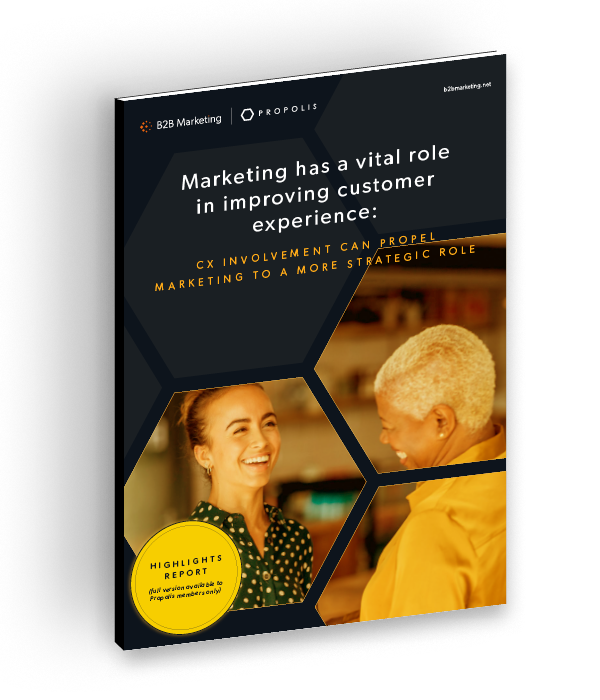
What role can marketing play in improving customer experience?
Do you want to see where marketers are at in their efforts to improve CX? Download this report to see what the state of play is, and how you can improve you CX today.
17 June 2021 · Customer Experience

Insights from our recent roundtable
In a recent B2B Marketing roundtable in association with Integrate, senior marketers came together to discuss the blurring lines between demand gen and ABM, and how they intend to continue building an integrated growth strategy.
17 June 2021 · Data and Insights

7 predictions for B2B customer experience in a post-pandemic world
The line between the B2B and B2C customer experience is blurring, forever changed by the pandemic. Over the past year, the requirement to work from home has generated a shift in corporate behaviours, creating a less formal, more personal environment in which to do business. An intimacy and informality has emerged, with dogs barking, deliveries arriving and children pestering parents during video calls. B2B firms have realised that the organisations they’re selling to consist of real people – people who, perhaps, love cooking Indian food, enjoy cycling, like taking the dog for a walk and watching their children play football at the weekends. The more B2B organisations get to know their clients at a personal level, the better the relationship becomes and the greater the customer experience. With 80% respondents in a Salesforce study saying their experiences are as important as a company’s products and services, organisations must rethink the B2B customer experience if they are to continue to meet clients’ expectations in a relevant, thoughtful way. At Pitney Bowes, the commitment to delivering a great customer experience is our North Star, guiding everything we do, but we’re still learning. Over the past year, we’ve adapted the service and the experience we deliver to our clients, to help meet their evolving needs. Here’s how we see the customer experience going forward: 1. Your clients will expect deeper levels of personalisation Just as we expect consumer brands to ‘know’ us and our preferences, the same is true with the B2B customer experience. B2B decision makers want humanised, personalised, helpful and relevant experiences to reduce complexity and save them time. They want businesses to anticipate their requirements beyond the ‘You liked that, now try this’ algorithm. Achieving this isn’t a Holy Grail of customer experience: it’s about building relationships, enhanced by data, tools and automation, combined with intelligence gathered from every interaction. 2. Self-service will remain popular The ability to problem-solve quickly and efficiently using digital tools is a preference we’ve experienced within our own clients over the past year. We’ve seen a growing number of clients using our web self-service tools. Even with complex B2B products and services, the option to self-serve plays a key role in delivering a great B2B customer experience. The SalesForce study found 65% would prefer to help themselves through self-service for simple issues. But self-serve won’t just be for issues resolution: McKinsey found that 97% of B2B buyers claim they will make a purchase in an end-to-end, digital self-serve model, with the vast majority very comfortable spending $50K or more online.
17 June 2021 · Customer Experience

Why your martech is failing (and how to fix it)
Everyone’s talking about martech, and for good reason - with the right solution in place, you could transform your organisation’s marketing and start seeing the results you’re looking for. But there’s not so much talk around the fact that martech solutions are failing to deliver in many B2B organisations - or how these businesses can fix this issue. All B2B marketers know how important it is to get a good ROI from every penny they spend, so it’s vital for businesses to ensure they’ve got the best tools to hand. If your martech solution(s) aren’t quite meeting your expectations, you’re not alone - in a recent B2B Marketing report, just 13% of marketers described their martech stack as ‘good enough'. But there are now so many tech solutions in the market, every business should be able to build an optimum martech stack - so there’s no reason to settle for a so-so solution. Working in an agency, we see a number of common martech mistakes made by B2B marketing teams - and fortunately, many have a simple fix. If your martech isn’t living up to the hype, you might be making one of the following mistakes... You’ve got the wrong solution There are currently around 8,000 martech solutions on the market, from email marketing and analytics tools to CRM and sales automation solutions. Every solution will have slightly different features and benefits, and some will help you with a range of marketing challenges while others are focused on solving a single issue for your team. With so many options to choose from, many B2B marketers find choosing a martech solution overwhelming - which can lead some to choose a tool that’s not quite right for their organisation’s needs. If you’re finding that your technology isn’t quite what you were looking for, then this might be the case in your business. Unfortunately, you will probably only realise that a solution’s not right for you once you’ve invested and implemented it. But that doesn’t mean it’s too late to fix the situation. If you suspect your solution’s not right for you, seeking advice from a specialist martech agency could help you to find one that will meet all of your needs. They should be able to help you to replace your existing solution with one that’s better suited, or find another solution that can work alongside your current tool and enhance its capabilities. However, this might not be necessary - they might find that your martech’s just not working because...
17 June 2021 · Marketing Operations and Technology (MarTech)

Here were some key diversity themes we discussed at Ignite USA
With so many different speaker sessions, Ignite USA touched upon many important topics, one of which was diversity. Here are some of the key diversity themes at Ignite USA that we need to continue talking about. Being an ally in B2B Being an ally in the workplace goes beyond the bare minimum, especially in B2B. Podcaster and author Shanita Akintonde started the conversation about being an ally in the workplace by explaining why it’s essential to care in the first place. She outlined some rules for marketers to use: Determine your attributes: create the perception of what you want people to take away from your company. Identify your target audience and audience needs: you can track analytical data about your customers, so bring that to the DEI space. Create and enhance your DEI platform: use steeped research to generate insights and a foundation for your DEI efforts. Creating a template can be incredibly helpful, especially for those that might be hesitant or even fearful of making or saying the wrong thing. Another concept marketers need to embrace is to aspire to greatness without fear. Talking about diversity can be scary, but, to be blunt, you need to overcome that fear, otherwise, you’ll never grow and be an advocate or ally. Shanita said: “What I want you to think about is what is the culture of your organisation? If I walked in, what would I feel like? What would I feel like when I walked into your space when I look around and see anybody that looked like me? Would I feel that people could relate to me? Probably not, because I'm a bit of an outlier.” These sets of questions establish why having allies is so important, as minorities and underrepresented groups are just that: the minority. Joseph Taiano, CMO of Accenture, continued the discussion on diversity as he shared his experiences as a member of the LGBTQ+ community. When he first joined Accenture, he joined an affinity group which brought together marginalised groups around a cause. At the time, Joe said he didn’t have many gay friends so he joined an LGBTQ+ employee resource group.
17 June 2021 · People, Teams and Skills

An inside look at Ignite USA and the post-Covid event economy
Well, that is a wrap for our second annual Ignite USA Zoomapolooza, hosted from the Cloud. Kudos to our great community for participating and our wondrous speakers and content contributors for sharing such incredible insights around DEI, CX, ABM and other acronym friendly content. As we navigate the post-Covid chapter, event goer and event manager alike have certainly adapted to what virtual learning and networking, all the good and not so good! Having said that, I would like to first give a mighty shout out to our B2B Marketing events team. Thirteen months ago, our team literally transformed our first planned live USA-based event into a vibrant online event on a first-time platform to boot. Fast forward through a year of mastering the new world of at scale virtual events, all that dedication and experience in hand, yielded an even more awesome 2nd annual Ignite USA. (Btw, our team chose this little SaaS Company a year ago called Hopin as our core delivery platform when they had 40 employees. Now they are one of the largest virtual event companies in the world, due in no small part to B2BMarketing.net! As for our second Ignite USA, we continued our good fortune attracting the industry’s top domain experts as speakers and panelists over the two-day conference and three separate tracks. From Shanita Akintonde as an opening keynoter live from the host city of Chicago to Michael Brenner’s always eye-opening insights on the back end of Day Two, we hope everyone learned valuable new insights. Our session moderators, Katie Martell, James Soto, and Shane Redding, kept the two days on track and as they do so well, summarized and calibrated each day’s affairs for all who attended. Keith Pigues gave a highly informative keynote around making growth marketing your core mission. Our second annual Ignite USA replicated our engagement with the community, and our content contributors were there again with engagement and if a topic has an acronym, it must be important! We made sure to cover the most requested subject matter our community wanted. From ABX to CX and from GDPR to CDP’s. Sessions covered the gamut from Programmatic ABM to Sam Karow’s presentation on B2BMarketing’s very own campaign for Ignite USA. Of note, we saw positive feedback on our sessions on DEI, how diversity and inclusion are top of mind for our marketer community. We heard firsthand from marketers how they are weaving this core team philosophy into actual practice. What was especially moving is hearing from real marketing practitioners who as minority executives shared their personal stories and how they continue to lead their companies in diversity initiatives. Kudos to Lauren McCadney Williams, Karen McFarlane, and Tyrona Heath! And as usual, our very own Joel Harrison as host, led several spirited discussions around the state of our industry and emerging hot topics; and shared throughout the conference, vital insights from around the globe on just what makes our industry move and how it marshalled through the Covid epidemic. Finally, thanks to our Advisory Board and Event Sponsors for their advocacy, networking, and support of Ignite USA. We hope to build on our success when we host our 3rd annual conference back in person, in Chicago next June, IRL and of course, online. It will be interesting to see how we all adapt to the new trend of networking and learning in person. But for you old fashioned types, you can also attend online! For more highlights on the different streams and topics from Ignite USA, check out our B2B Takeaways Report here!
15 June 2021 · Content, Creative & Campaigns

Perspective 2021: a shift in focus for the industry’s leading marketers
Three quarters of global tech marketers say their organisation has been more creative in their go-to market approach in 2020 compared to previous years, according to a new survey from creative studio Shaped By.
15 June 2021 · Content, Creative & Campaigns

Global report by ON24 shows use of webinars triples
Research from ON24, the provider of a cloud-based digital experience platform that offers webinars, virtual events and always-on multimedia experiences, demonstrates just how important webinars have become.
11 June 2021 · Data and Insights

The challenges of global messaging, and a better path forwards
Delivering a message that resonates with your audience may be manageable when you’re only targeting certain buyers in a certain region, but things get a lot more complicated when you try and spread this same message on a global scale. In our recent roundtable in association with The Mx Group and Bray Leino, senior B2B marketers came together to discuss their challenges in this area, and how they’re going about delivering a truly global message that resonates with their buyers.
11 June 2021 · Content, Creative & Campaigns


