



Resources
Case studies, webinars, reports, podcasts and videos from B2B Marketing, in one place.
Featured
Best practice briefing
A guide to overcoming the biggest challenges to becoming a commercial marketer.
A guide to overcoming the biggest challenges to becoming a commercial marketer.15,425 results · page 82 of 643

The secret to winning a B2B Marketing Award
Looking for some inspiration while entering our B2B Marketing Awards? Well, we’ve got just that with an exclusive interview with twogether about their outstanding 21 wins over the past 4 years. Kavita Singh spoke with Alex Webber, marketing manager at twogether. KS: Just this year, you won an award for a new category we started doing at our martech awards called 'Best use of martech for brand building'. What was the reaction from your team? AW: It was huge! This was the first time you had released this award category, but it was also the first time we had entered that specific campaign into any awards. It was amazing to get the recognition, and there are a few reasons for our delight. Firstly, we loved that you included a brand-building category during a time when marketers were reluctant to spend on brand campaigns. With more companies deciding to channel their budgets towards demand generation, this win demonstrates how the balance between brand and demand is key to success. On top of that was the fact this award showed how much of a role martech has to play when it comes to brand building. Martech teams are usually quietly supporting brand building so to be able to get recognition for their usually unseen effort was amazing. Martech’s role is to manage the technology and identify opportunities for improvement, but it’s the combined knowledge of everyone involved that has made this win possible. Across our internal teams, as well as within O2 and their supporting teams all working together. KS: What was the goal with that campaign and what was one key highlight? O2s’ goal was to drive acquisitions, fame, differentiation, and consideration in the SMB market around their new brand narrative “We’re here to help your business flex”. For us, this was a great opportunity to implement and enable new channels and technologies bringing a fresh perspective to the program. With the expansion of these new channels, we were able to tangibly track the success of the content and context of each element – ensuring that we enhanced the reach of the brand awareness activity. This also meant that we were able to append lead data with the information needed for O2’s existing tech stack, not only transferring leads quickly but automatically activating nurture activity, based on the content of engagement. KS: You also won for 'Best use of martech in demand generation' The results were outstanding! What was your reaction to the results? AW: The demand generation piece for us was a part of a much bigger picture of the martech support and integration we’ve been supporting O2 with over the last 24 months. So first and foremost, winning both categories was just brilliant because it just goes to show exactly why you need a balance between brand and demand generation to produce the best results. The results were outstanding, and it goes to show you don’t have to be a specialist Martech agency to be effective and get award-winning results. Our team is working in a much bigger integrated model and working with the clients and working with the partners we’ve been able to get this holistic view of every piece of the puzzle to make the campaign work.
6 May 2021 · Content, Creative & Campaigns
Barriers to great B2B content
68% of B2B marketers are not proud of their own content. This report reveals why.
6 May 2021 · Content, Creative & Campaigns

Unlevelling the playing field
Read Lesniak Swann's latest guide into how brands can create an unlevel playing field that gives them an unfair competitive advantage.
6 May 2021 · Content, Creative & Campaigns
Are you a digital Victorian?
Read this guide by Lesniak Swann to find out if your brand is a digital Victorian.
6 May 2021 · Brand

Demandbase announces acquisition of InsideView and DemandMatrix and launches Demandbase Data Cloud and Sales Intelligence Cloud
Account-based marketing platform Demandbase has announced its acquisition of both sales and marketing intelligence provider InsideView and technographic data and intelligence provider, DemandMatrix. With these acquisitions, Demandbase now offers a complete “one-stop-shop” for quality data across the five key components required for B2B go-to-market including Firmographics Technographics Intent data Account identification Contacts These acquisitions also help expand the Demandbase One B2B Go-To-Market Suite. Along with its ABX Cloud and Advertising Cloud capabilities, the new Data Cloud and Sales Intelligence Cloud allows Demandbase One to provide data for understanding accounts, engaging with the right customers and taking action across multiple channels. The Data Cloud also includes Data Integrity, a customer data management provider that cleans, monitors and unifies CRM data with up to date information. Gabe Rogol, CEO of Demandbase, said: “We’re proud to join forces with these two great companies. Our vision is bold. We are transforming how B2B companies go to market, helping them deliver great experiences at every stage of the account journey. This requires great data — and we now have the premium B2B data and intelligence solutions to help companies identify, understand, and engage their customers and prospects. With this move, Demandbase moves from being ‘just’ a leader in account-based programs to being the definitive leader in B2B go-to-market.” With the acquisition of InsideView and DemandMatrix, we've officially evolved into a B2B cloud company with the ability to offer four different clouds, including the new Sales Intelligence Cloud and the Data Cloud, under one roof. This is an exciting transition and a move that fundamentally shifts Demandbase from an ABX company to a full, B2B go-to-market suite.”
5 May 2021 · ABM & Demand Generation

The fastest growing US agencies revealed
Each year, the B2B Marketing US Agencies Benchmarking Report reveals the fastest growers in the US agency marketplace. With the report now available to download, here’s a quick breakdown of some of the fastest growers.
5 May 2021 · Content, Creative & Campaigns

B2B marketing: Why it’s all about a B2i experience
Marketing has changed significantly over the last five years and it’s hard to keep up, let alone get ahead. There have been many improvements in data analysis, testing, ABM, snackable content and gamification, but underneath this layer of playbook tactics, one fundamental element has not changed… marketing still needs to deliver to your business’s ultimate audience: the customer. It’s about telling a cohesive story and making your customer its hero, which means taking a long hard look and updating our B2B marketing playbook. The focus shift to B2i B2B marketing is about the relationship between a vendor and its products. It can be a transactional selling experience which if not managed carefully, can feel cold and impersonal. Yet decision makers are people, not businesses, hence why thinking a bit more like B2C should make sense. They are all targeting individuals who each have motivations, priorities, affinities, and an individual buyer state which we all need to be attuned to. B2B marketing therefore becomes even more powerful when we bring together the best of B2B and B2C marketing to deliver a B2i (business to individual) experience. As B2B marketers, we have a big opportunity if we recognise our advantage — marketing is as close to the customer and prospect as the business can get. Our entire agenda is to understand the individual and build relationships rather than just making a transaction. With this in mind, it will also change the way we measure and think about our marketing approach. The volume of leads, length of the sales process and time spent on your website are always going to be valuable data points. But these are outcomes derived from the goal of understanding which audience we really want to spend time with, what their motivations are, where they go and what they consume, as well as knowing what it is that gives them sleepless nights and what they need in order to be successful.
5 May 2021 · Customer Experience

Engaging With Small Business Will Never Be the Same Again
Get the game-changing results of the latest study from B2SB Marketing® Agency, Cargo
5 May 2021 · Strategy and Evolution

Securing new business during difficult times – the value of phone follow up
Download this article to discover five ways a disruptive channel such as the phone used in a targeted, systematic way can add value to your follow up process.
5 May 2021 · Content, Creative & Campaigns

Intent data provider Cyance announces new funding round to build on growth
Intent data provider Cyance has announced a new round of additional funding from investors including Blackfinch Ventures and Nexus Investments, in the amount of £860,000. The company plans on leveraging the funding to continue to grow its team internally, which has doubled in size over the past year. It will also be used to accelerate the company’s enterprise customer acquisition strategy. It also aims to build its increasing value from an ABX perspective for global organisations with a European positioning. Jon Clarke, Founder, chief product officer of Cyance, said: “What I mean by that is building out our geographic coverage of behaviour that we can pick up with the 55,000 publishing websites that whilst then spans across the US and Europe and Asia, there’s a real strength in Europe and that means greater coverage across a wider set of websites - not just in English. If organisations are thinking seriously about redefining their customer strategy with insights and giving themselves a competitive edge, then we are placed to deliver that both in Europe but also in six different languages.” The news comes after a period of significant growth for the startup with revenue increasing by 18% and customer value increasing by 30% in the past year. Jon continued: “This past year has been unprecedented but we’ve seen steady growth with new customers and we haven’t lost many customers either which was a real concern to our market and the wider world. We’ve always had a flexible working environment because our development teams are based in other countries. But what we realised is that our customers have had to adapt in a very similar way. So they need to innovate in their customer strategies but from an acquisition, retention and expansion point of view. Therefore, they need to transform their way they go to the market using technology like us and has allowed us to see our value proposition.”
4 May 2021 · Data and Insights
The future of digital communities with Susanna Kempe, Ashley Friedlein & Zoe Merchant
In this week's episode, B2B Marketing editor-in-chief Joel Harrison spoke with Susanna Kempe, Chair at B2B Marketing; Ashley FriedleinCEO and founder at Guild; and Zoe Merchant, managing director at Bright, about digital communities in 2021.
1 May 2021 · Strategy and Evolution
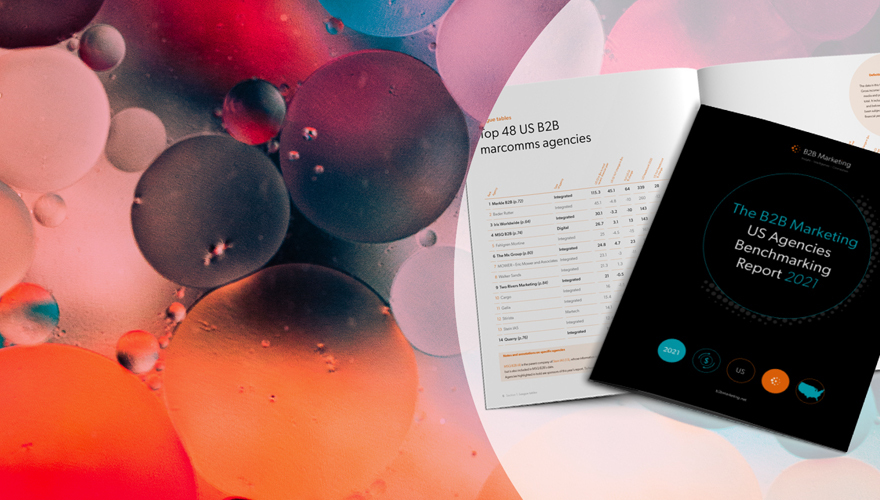
The state of the US agency marketplace
Each year, our US Agencies Benchmarking Report asks agencies about their income, headcount, challenges, focus areas and more. In this feature, David Rowlands, editor, takes a look at their replies, and presents a lay of the agency landscape.
30 April 2021 · Content, Creative & Campaigns

How to stay human in an online world
Read this 10-minute tool from Rooster Punk to learn how you give your B2B marketing that human touch.
29 April 2021 · Content, Creative & Campaigns

Creating content for a better customer experience journey
Content marketing is nothing new. In fact, some of our fellow marketers claim it to be as much as 300 years old. In 1739, Benjamin Franklin first published his annual ‘Poor Richard’s Almanack’; a popular pamphlet in the American Colonies which was packed full of practical and witty proverbs. The purpose of the Almanack was not only to enlighten its readers (and enrich their souls), but also to promote Franklin's growing print business - and thus, content marketing was born. Fast forward to 2021 and the creation of good content rests on much the same principles: make it relevant, timely, useful and interesting. The creation of a good content marketing strategy however, has become a little more complex. Unlike Franklin, who knew his audience as well as he knew himself - and had paper and print as his only real option for promoting his paper and print business - today’s marketers must promote a broad array of products and services, often to several different audiences and via multiple channels. Today, content marketing is no longer simply about telling a story: it’s also about telling the right story, in the right format, on the right platform. Much of this will depend on which stage of the customer journey it’s designed for and what its specific purpose is. Your content needs to be capable of moving prospects and customers along their journey - taking them from awareness through to purchase, before bolstering brand loyalty and then creating opportunities for referral. Mapping out the customer journey With so much to consider, it can be difficult to know where to begin. But isn’t every complicated journey easier with a map? Mapping out the customer journey for each of your primary audience personas is a brilliant way to see each possible touchpoint and understand how it can be an opportunity to build awareness, engage a new prospect, convert a lead, enhance a customer’s experience, and eventually turn a loyal customer into a brand advocate. It will also show you how different pathways interconnect and where roads might end: the best content strategy will be one that considers how relationships that might otherwise turn cold can be nurtured, to keep you front of mind until a buyer is ready to commit. At each stage of the journey, the main question you need to keep in mind is ‘what action do you want the audience to take?’. Consider these actions the signposts on your roadmap and get it all clearly laid out in a way that makes sense to you (and that you can keep referring back to). This roadmap will be invaluable to you later down the line. Now you’re ready to start creating content.
29 April 2021 · Content, Creative & Campaigns

3 tips for using intent data for ABM
In B2B marketing, using intent data for ABM is good in theory, but there are some key practices you need to take into account. Kavita Singh spoke with Propolis Hive Expert for Data Strategy, Insight and Intelligence, Tony Lamb, and partner at Data Protection Network Associates, Julia Porter, about some top tips. Find a supplier you can trust Researching your intent data platforms is absolutely critical. When they state they’re GDPR compliant, make sure you ask how they’ve ensured this. Julia says: “If I were a marketer, I would be carefully looking at the contracts of all these individual partners and ask how rigorous they are at managing all these databases and how transparent they can be to the individual around consent to make sure they are following best practice.” Any supplier contract should have some kind of questionnaire with the provider, asking what data they’ve been collecting, how they’re processing that data, how securely that data is being managed, and if they’ve done any sub-processing of that data. In return, they should be able to provide reassurance back to the supplier about those questions. Julia says that questions also start to arise around international data transfer, as well questions such as: Where is that data being kept? Is it being kept in Europe? Is it being kept in the US? In addition, the conversation can bring up questions on managing your suppliers, such as: Are you managing clients effectively? What are your data sources? Is data collected at corporate contact level? If you collect at contact level, do you use consent? If you use legitimate interest, do you use sole traders? How is consent evidenced? Ensure you’re open and transparent Julia says: “The world is a bit complicated, particularly around digital data. Lots of different parties are involved and not everyone understands. Not everyone is going to understand what is happening to their data. But, having said all that, you can’t just leave it.” While it may not be simple to comprehend, you need to understand where that data has come from and what they’re going to do with it. Tony explains: “A lot of B2B data isn’t personal data. So, if you’re part of a limiting company and not a sole trader or partnership, you’re being communicated within that function of that business. That’s not considered personal data; it’s corporate data. Your challenge with B2B data is then: can you identify which bits are personal data and which bits aren’t?”
29 April 2021 · Data and Insights

Marketing Impacts of a Global Pandemic
In this report you will learn what challenges product and content marketers face and how to overcome them.
28 April 2021 · Content, Creative & Campaigns
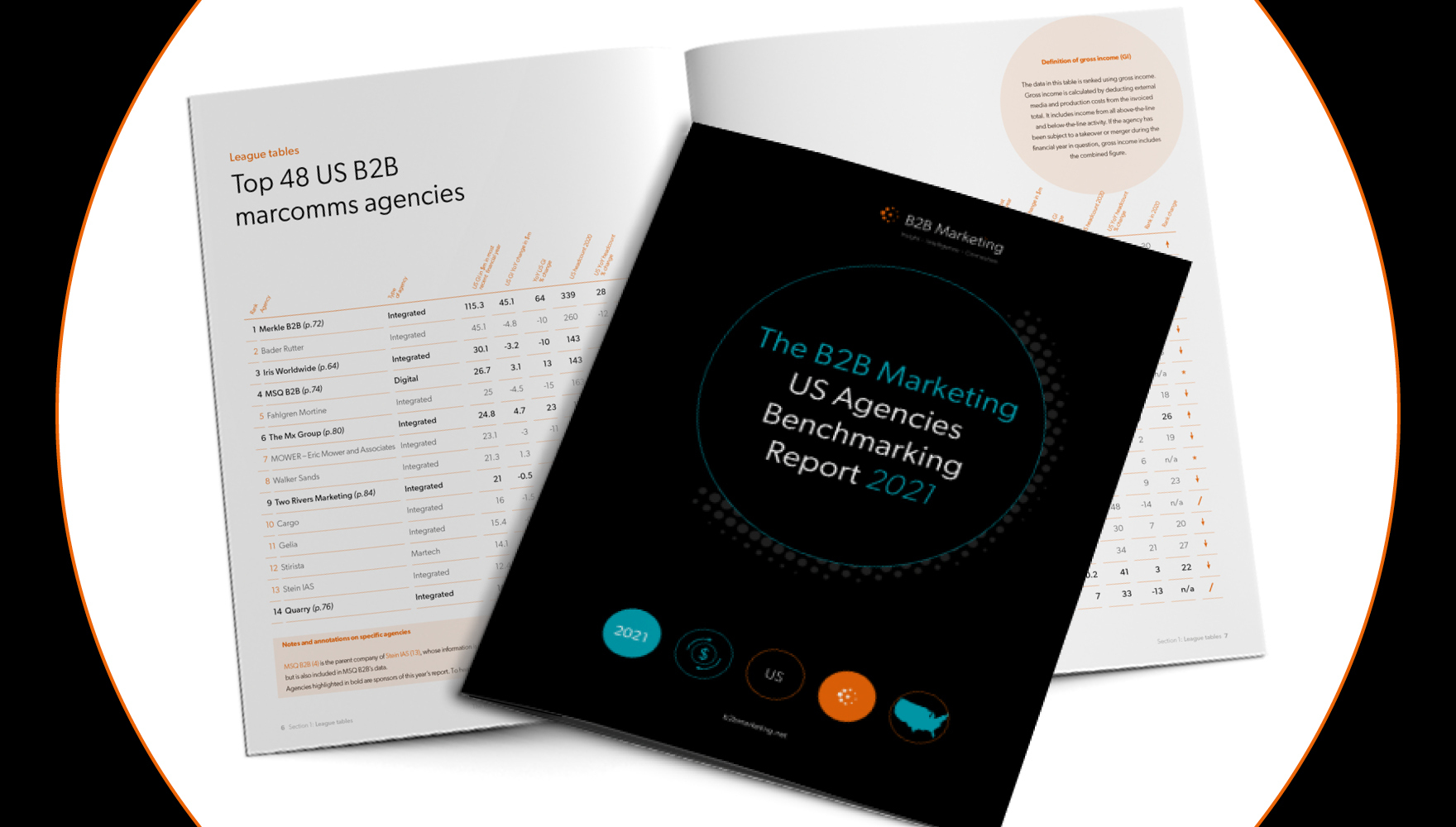
The B2B Marketing US Agencies Benchmarking Report 2021 is out now!
With so many US B2B marketing agencies out there, getting your bearings can be difficult. Who’s the biggest? Who offers this service or that service? Who meets the needs of your organisation? Fortunately, we’ve done the hard work for you, and are happy to announce that our annual US Agencies Benchmarking Report is out now.
28 April 2021 · Content, Creative & Campaigns
Repeat success in your B2B marketing with the power of revenue attribution
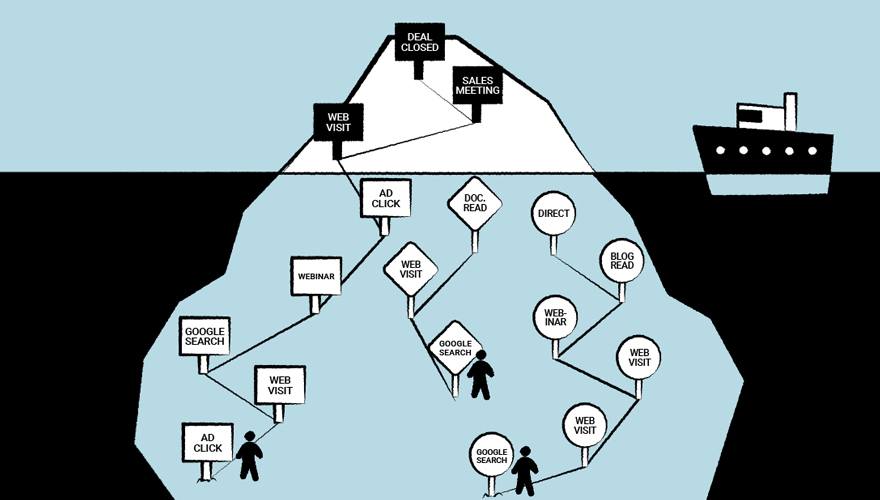
Let’s face it: we’re drowning in data. Demand generation and marketing professionals are doing their best to piece together B2B customer journeys, looking for the touchpoints beyond the tip of the iceberg that landed them that one deal. What worked? What didn’t? What needs to be scaled down? Scaled up? Cut out entirely? Was it that Facebook ad? The blogpost everyone on your team put so much effort into? Or did that last phone call seal the deal, because your salesperson is a rockstar? In short: which marketing channels should get the credit for closing a deal? Can you really trust the numbers? And how can you repeat success once you’ve identified it, and stop wasting money on the content and campaigns that don’t work? This is where you want to take a close, hard look at B2B attribution, and stop relying on tools made for B2C scenarios. In this article, we’ll cover the following so you can set your B2B business up for repeated success with attribution: The difference between B2B and B2C growth, and the costly consequences of using B2C tools for B2B scenarios Going from generic to specific data and taking charge of your own data Using attribution models the right way and setting up realistic expectations The difference between B2B and B2C growth B2B customer journeys often involve lengthy timelines, multiple teams, and multiple stakeholders, making it harder and quite complicated to accurately attribute the right credit to the channels and touchpoints that tipped the scales in your favor. B2C tends to be more straightforward, because you can (mostly) attribute conversion to a single touchpoint in your customer’s journey. More often than not, the first or last interaction did the trick, which is why single-touch attribution models work quite well for B2C scenarios. Of course, some B2C journeys can be a little more complex than that, but overall, it’s a little easier to maintain the overview than for the B2B counterpart. Many cooks in the kitchen So what is it about B2B customer journeys that make it so hard to correctly capture data and attribute credit? First of all, B2B may stand for “business to business”, but a business still consists of people at the end of the day. Business is one group of people talking to another group of people. In other words, you’re not selling to an individual; you’re selling to an account, consisting of many stakeholders with many opinions and busy schedules. This creates an abundance of interactions that occur at different points over a long period of time.
28 April 2021 · Content, Creative & Campaigns

Hotwire acquires McDonald Butler Associates, strengthening position as leading tech communications consultancy
Global tech communications consultancy, Hotwire, has announced that it has acquired McDonald Butler Associates (MBA) – a strategic B2B sales and marketing agency specialising in the technology industry.
27 April 2021 · Content, Creative & Campaigns

7 ways to accelerate B2B digital transformation
Digital transformation can mean many things for many different businesses. But there will be common threads for companies running across diverse sectors. You might be surprised by some of the common painpoints, solutions and opportunities which unite B2B business leaders challenged with bringing their companies headlong into the post-Covid world. We spoke to three such leaders to gain understanding from their experiences. Jürgen Winterholler who leads the IT and Digital Solutions at Rolls Royce Power Systems, Leo Pickford charged with Transformation at Yusen Logistics and Alex Wodzicki, Group Digital Marketing Director at warehousing giant Segro. The business leaders Leo Pickford, head of business change, Yusen Logistics Jürgen Winterholler, VP, Chief IT Digital Officer, Rolls Royce Power Systems AG Alex Wodzicki, Group Digital Marketing Manager, Segro Here are some the key learnings and considerations to come out of those experiences: 1. Change mindsets For those tasked with digital transformation in a business, their role can often be one of evangelism. Infrastructure problems are not unusual, and it's clear that much work is done to try and help define what transformation means across the wider business. With multiple stakeholders and different priorities, addressing the elephant in the room is often the first challenge. Alex Wodzicki at Segro says it like it is: “There are different people (in the business) who have different ideas of what digital transformation actually means.” In order to overcome some of these issues it seems that the first task is actually to change mindsets and to ensure that digital transformation is recognised as being integral to business change. So at RRPS Juergen Winterholler’s first act on his appointment to his role as head of IT and digital was to start a programme he called “Impact to be proud of” – developing solutions with people and principles together. “I built up a structure where I have one team. They are called customer solutions and this is my front end to the customer. They are talking to the customer asking “What is your pain? What is your need? What is your daily problem? What would you like to solve?” They're listening to the customer and translating what we have to do. We have one voice to the customer and one face to the customer. They are experts in the business, and this is a total change of the setting of the thinking of the organisation. And of course internal customers will be happy about this new setting. They feel more heard and understood.” And at Yusen, Leo Pickford has a similar understanding about the need for a mindset shift – which doesn’t necessarily make his job easier but certainly ensures speed is a prerequisite: “It's a different mindset. It is a mindset that says doing things digitally should be easy. Just get it done. It’s got to start with a strategic look at the way the market’s going, but ultimately you have to get on with it, try things out and pilot your ideas.” But for Pickford as for others the mindset shift is not as readily joined by all parts of the business. For some digital solutions are understood to be a rapid enabler of business requirements. In some areas they can be seen as a threat, as testified to by Wodicki: “Sometimes people when you explain what can be done, they say, well, that's probably a step too far. We don't need to go that far, but it would be nice to have a certain amount. And that's where it's quite interesting… there is more of an appetite to go down the digital route.” To learn more about Candyspace, click here.
23 April 2021 · Content, Creative & Campaigns

B2B Media Group hires ex-Criteo executive as its VP Product
Data company, B2B Media Group, has appointed former Criteo executive, Andreas Misera as its VP Product. He will be driving growth of its B2B data platform, B2B.IQ and help accelerate product developments for other B2B companies. Andreas brings more than 20 years of experience in digital marketing and technology as he had recently led Criteo’s technical and data & analytics operations in Central Europe, Russia/CIS, the Middle East and Africa for several years. Prior to Criteo, he held positions at Adconion and Yahoo. By providing B2B user and company targeting and intent data through its B2B.IQ platform, B2B Media Group supports over 500 of B2B companies and media agencies in Europe and the US to achieve its marketing and sales goals. Fabian Jung, CEO of B2B Media Group said: “We're honored to have Andreas on board as his expertise on both a product and organisational level will be vital in advancing B2B Media Group’s growth strategy. Andreas will focus on further developing our B2B.IQ data platform and the services that are built on top of it like account-based marketing, intent scoring and lead & display solutions. His AI and machine learning background will give us a competitive edge in how we analyse and gather data from more than 500 B2B sources and make it actionable for advertisers around the globe.”
23 April 2021 · ABM & Demand Generation
Need-to-Know: Essential 2021 insights into SMBs for Enterprise Marketers
Watch this session to understand why SMBs might choose to buy from certain enterprise brands and not others. And what you can do about it.
22 April 2021 · Strategy and Evolution
Enabling the future of sales with Gabriela Warren, Tim Hughes & Barry Richards
Covid-19 has changed the nature of sales engagements, restricting face-to-face meetings or events for the foreseeable future, making buyers harder to reach than ever. In this week's episode, editor-in-chief Joel Harrison hosted a three-panelist discussion which included expertise from Gabriela Warren, senior director in marketing at Highspot; Tim Hughes, CEO and founder of DLA Ignite; and Barry Richards, strategy and planning director at Transmission.
21 April 2021 · Strategy and Evolution

Intermedia Global acquires Junction to go beyond data and marketing
Intermedia Global has announced the acquisition of award-winning B2B marketing agency Junction. Using its strategic, creative and technology capabilities, Junction will assist with Intermedia Global’s data marketing solutions. They will now offer services that power marketing and sales for a range of B2B organisations including ABM programmes, mass-market approaches and much more. Junction is a B2B marketing communications agency that specialises in content, creative and digital marketing. They have also won several awards including best Marketing Agency and a number of B2B Marketing awards. Steve Kemish, managing partner of Junction said: “We are delighted to combine our services with IMG. Having partnered on several projects over the years, we know that our services are incredibly complementary. They share the same values as us and the whole team is looking forward to working as one. I personally relish the chance to lead the new organisation as CEO, working closely with Neil in his new role as Executive Chairman.”
21 April 2021 · People, Teams and Skills


